
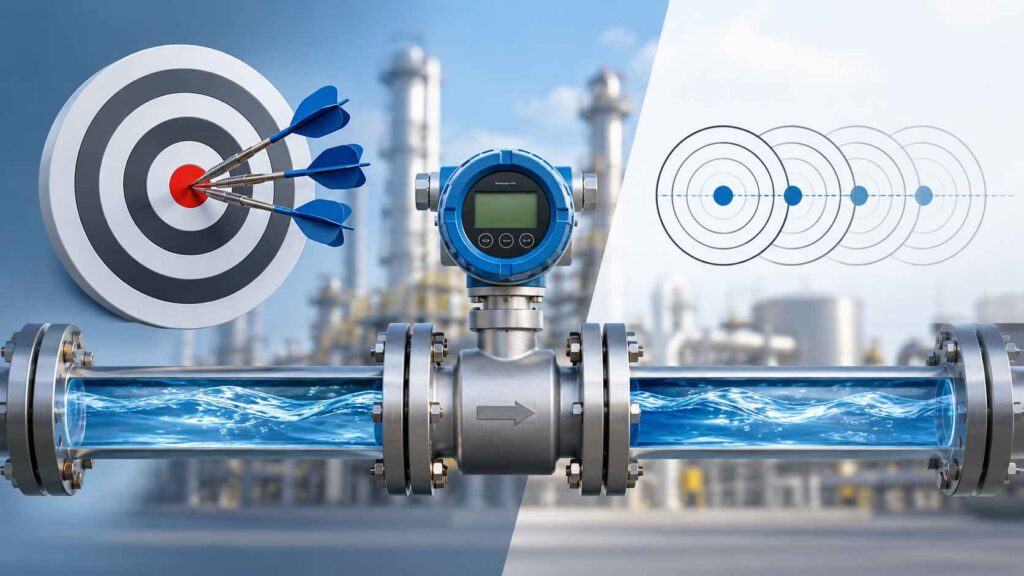
When selecting a flow meter for an industrial process, two specifications often create confusion: flow meter accuracy and flow meter repeatability. Although both describe measurement performance, they do not mean the same thing.
Understanding flow meter accuracy vs repeatability is important when choosing a meter for water, chemicals, oil and gas, steam, compressed air, process fluids or other industrial applications.
A flow meter can provide highly repeatable readings without being highly accurate. Similarly, a meter that is not repeatable cannot provide dependable measurement performance. This article explains the difference, how the specifications are expressed, what affects them and how to use them during flow meter selection.
Flow Meter Accuracy vs Repeatability: Quick Comparison
Accuracy
How close the measured flow is to the actual or reference value.
Repeatability
How consistently the flow meter produces the same result under the same conditions.
Selection
Both specifications should be considered according to the application.
What Is Flow Meter Accuracy?
Flow meter accuracy describes how close the indicated flow measurement is to a known, reference or actual flow value. It is one of the most important specifications to evaluate when selecting a flow meter.
For example, if the actual flow is 100 m³/h and a flow meter indicates 99 m³/h, the measurement has a deviation from the reference value. The permitted deviation depends on the accuracy specification of the instrument.
Flow meter accuracy is commonly expressed as a percentage such as ±0.5%, ±1.0% or another specified value. However, the percentage alone is not enough. You must also determine whether the accuracy is specified as a percentage of reading, full scale, span or another reference.
Key point:
A smaller accuracy percentage generally indicates a tighter measurement
specification. Always check the manufacturer's exact accuracy definition and
operating conditions rather than comparing percentages alone.
Why Flow Meter Accuracy Matters
Flow measurement accuracy becomes particularly important when the measured flow affects product quality, energy consumption, production calculations, chemical dosing, billing or custody transfer.
For example, an error in a large-volume water, fuel or chemical measurement can accumulate into a significant difference over time. In a batching process, inaccurate flow measurement can also result in overfilling or underfilling.
What Is Flow Meter Repeatability?
Flow meter repeatability describes the ability of a meter to produce consistent readings when the same measurement is repeated under the same specified conditions.
Imagine a process where the actual flow remains stable at 100 m³/h. If the meter repeatedly produces readings such as 99.9, 100.0 and 100.1 m³/h, it demonstrates good repeatability.
Repeatability is therefore mainly concerned with consistency. It does not automatically mean that the measurement is close to the actual flow.
Did You Know?
A flow meter can be highly repeatable but still have a systematic measurement error. For example, if the actual flow is 100 m³/h and the meter consistently indicates approximately 103 m³/h, the readings may be very repeatable even though they are not accurate to the same degree.
Flow Meter Accuracy vs Repeatability
The simplest way to understand flow meter accuracy vs repeatability is to remember two questions:
Accuracy
“How close am I?”
“How close am I?”
→
Actual / Reference Flow
←
Repeatability
“Can I get the same result?”
“Can I get the same result?”
Flow Meter Accuracy
- Concerned with closeness to the reference value.
- Describes measurement correctness.
- Important for quantitative measurement.
- Often specified as a percentage.
- Important for billing and custody transfer applications.
Flow Meter Repeatability
- Concerned with consistency.
- Describes how closely repeated readings agree.
- Important for process control and trending.
- Useful for detecting changes in a process.
- Does not by itself guarantee measurement accuracy.
Accuracy and Repeatability Using a Simple Example
A simple target analogy can help explain the difference between flow meter accuracy and repeatability.
| Condition | What the Readings Look Like | Meaning |
|---|---|---|
| High accuracy + high repeatability | Readings are close to the actual value and close to each other. | Ideal measurement performance. |
| Low accuracy + high repeatability | Readings are close to each other but consistently offset from the actual value. | Consistent but biased measurement. |
| High accuracy + poor repeatability | Individual readings vary significantly. | Unstable measurement performance. |
| Low accuracy + poor repeatability | Readings vary and are also far from the actual value. | Poor measurement performance. |
Flow Meter Accuracy vs Repeatability: Practical Example
Consider an industrial pipeline where the actual flow is approximately 100 m³/h.
Meter A provides readings of 99.8, 100.1 and 100.0 m³/h. These measurements are close to the reference value and close to one another.
Meter B provides readings of 103.0, 103.1 and 103.0 m³/h. The readings are very consistent, but they are offset from the actual value.
| Meter | Actual Flow | Repeated Readings | Observation |
|---|---|---|---|
| Meter A | 100 m³/h | 99.8 / 100.1 / 100.0 m³/h | Good accuracy and repeatability |
| Meter B | 100 m³/h | 103.0 / 103.1 / 103.0 m³/h | Good repeatability but measurement bias |
This example demonstrates why flow meter accuracy vs repeatability should not be treated as the same specification.
How Is Flow Meter Accuracy Specified?
One of the most important points during flow meter selection is understanding how the manufacturer's accuracy specification is defined.
Accuracy as a Percentage of Reading
When accuracy is specified as a percentage of reading, the permitted error is related to the measured flow value.
For example, with a hypothetical accuracy specification of ±1% of reading at 100 m³/h, the indicated value could have an error of approximately 1 m³/h under the stated conditions.
Accuracy as a Percentage of Full Scale
Full-scale accuracy relates the permitted error to the maximum scale or configured full-scale value. This distinction becomes particularly important when the actual operating flow is significantly lower than the full-scale value.
Important:
Do not compare two flow meters simply because both are specified as “±1%”.
Check whether the specification is based on reading, full scale, calibrated span,
flow range or another reference.
Why % of Reading and % of Full Scale Matter
Consider two flow meters with the same nominal percentage but different reference bases. Their actual measurement error at a particular operating flow can be very different.
This is why the normal operating flow, minimum flow and maximum flow should be considered before selecting a flow meter. Industry guidance recommends evaluating the complete expected operating envelope rather than looking only at one nominal flow value.
Accuracy, Repeatability and Rangeability
Accuracy and repeatability are not the only specifications that matter. Another important parameter is rangeability, sometimes discussed together with turndown ratio.
Minimum Flow
→
Measuring Range
→
Maximum Flow
A flow meter may have excellent accuracy around its preferred operating point but may not provide the same performance at extremely low flow rates. Therefore, the actual process flow range should always be compared with the manufacturer's published performance data.
Factors Affecting Flow Meter Accuracy and Repeatability
Flow meter accuracy and repeatability depend not only on the meter itself but also on how it is selected, installed and operated.
1. Flow Range
Operating far below the recommended flow range can affect measurement performance. Select a meter that is properly sized for the expected minimum, normal and maximum flow conditions.
2. Fluid Properties
Density, viscosity, conductivity, temperature, pressure and composition can affect the suitability and performance of different flow measurement technologies.
3. Installation Conditions
Incorrect installation can affect the performance of a flow meter. Pipe geometry, flow profile, valves, elbows, reducers, pumps and insufficient straight pipe lengths can all influence the measurement.
4. Temperature and Pressure
Changes in process temperature and pressure can influence fluid properties and therefore affect the measurement performance of some flow meter technologies.
5. Calibration
Calibration establishes the relationship between the flow meter output and a reference measurement. Calibration condition, traceability and the stated uncertainty should be considered when evaluating performance.
6. Flow Profile
Some flow meter technologies are sensitive to disturbed flow profiles. Proper upstream and downstream piping arrangements can therefore be important.
Tip:
Before selecting a flow meter, document the minimum, normal and maximum flow, fluid properties, operating temperature, operating pressure, pipe size, required accuracy and installation conditions. This gives the supplier enough information to recommend a suitable technology and size.
How to Consider Accuracy During Flow Meter Selection
Choosing a flow meter based only on the highest accuracy number is not always the best approach. The required performance should be matched to the process.
Step 1: Define the Required Flow Range
Determine the minimum, normal and maximum expected flow rate. A meter should be selected around the actual operating envelope rather than only the nominal pipe size.
Step 2: Identify the Measurement Objective
Ask whether the flow measurement is required for indication, monitoring, process control, batching, energy management, inventory measurement or custody transfer.
Step 3: Determine the Required Accuracy
Not every application requires the same level of flow measurement accuracy. A process monitoring application may have different requirements from a custody transfer or precision dosing application.
Step 4: Check Repeatability
If the meter is being used for process control, stable and repeatable measurements can be extremely important. Consistent readings allow the control system to respond to genuine process changes rather than measurement noise.
Step 5: Check the Manufacturer's Conditions
Review the conditions under which the published flow meter accuracy is achieved. These may include fluid properties, flow range, temperature, pressure, installation configuration and calibration conditions.
Selection rule:
Do not ask only, “Which flow meter has the highest accuracy?” Instead ask, “What accuracy and repeatability does my process actually require, and under what operating conditions?”
Where Accuracy and Repeatability Matter
Water and Wastewater
Water treatment applications often require reliable flow measurement for process control, chemical dosing, distribution and monitoring. For background on flow measurement in water and wastewater applications, see our Flow Measurement in Water and Wastewater Treatment Plants .
Oil and Gas
Flow measurement accuracy can become particularly important when the measured quantity affects allocation, inventory or commercial transactions. Meter repeatability is also important for stable monitoring and process control.
KLEEV's instrumentation knowledgebase also covers the broader role of instrumentation in refineries , where reliable flow measurement is one part of overall process measurement.
Chemical Processing
Chemical dosing and process control can depend on stable and predictable flow measurement. Depending on the application, both accuracy and repeatability may need careful consideration.
Steam and Energy Measurement
Steam flow measurement is often connected with energy management and process efficiency. Selecting a suitable flow meter requires consideration of the operating pressure, temperature, flow range and measurement requirements.
General Industrial Flow Measurement
KLEEV's flow meter selection guide provides a broader framework for choosing flow measurement technology according to the application.
Common Mistakes When Comparing Flow Meter Accuracy
1: Comparing Percentages Without Checking the Reference
Comparing ±1% of reading with ±1% of full scale can give a misleading impression. Always check the complete specification.
2: Assuming Repeatability Means Accuracy
High repeatability does not automatically mean that the meter is measuring the actual flow correctly. Repeatability describes consistency, while accuracy describes closeness to the reference value.
3: Ignoring the Operating Range
A meter's published accuracy should be evaluated across the actual flow range. Selecting a meter that is oversized for the application can make low-flow performance an important consideration.
4: Ignoring Installation
Even a high-performance flow meter can produce poor results when installation conditions are unsuitable. Always follow the manufacturer's installation requirements.
5: Selecting Only by Price
The lowest purchase price does not necessarily provide the lowest overall cost. Consider measurement performance, calibration requirements, maintenance, reliability and the financial impact of measurement errors.
Flow Meter Accuracy and Repeatability Checklist
| Parameter | Question to Ask |
|---|---|
| Flow range | What are the minimum, normal and maximum flow rates? |
| Accuracy | How close must the measurement be to the reference value? |
| Repeatability | How consistent must repeated readings be? |
| Specification basis | Is accuracy stated as % reading, % full scale or another basis? |
| Fluid | What are the fluid properties and operating conditions? |
| Installation | Are the piping and flow profile suitable for the selected technology? |
| Application | Is the meter used for indication, control, batching, billing or custody transfer? |
Frequently Asked Questions
What is the difference between flow meter accuracy and repeatability?
Flow meter accuracy describes how close a measurement is to the actual or reference flow value. Repeatability describes how consistently the flow meter produces the same result when the same conditions are repeated.
Can a flow meter be repeatable but not accurate?
Yes. A flow meter can consistently produce readings that are offset from the actual flow. In that situation, the meter can have good repeatability but poorer accuracy.
Is higher flow meter accuracy always better?
Not necessarily. The required accuracy depends on the application. High-accuracy performance may be essential for some commercial or precision processes, while other monitoring applications may not require the same level of accuracy.
What is more important, accuracy or repeatability?
Both can be important, but their importance depends on the application. Accuracy is critical when the measured value must closely represent the actual flow. Repeatability is particularly important when consistent measurements are needed for process control, trending or repeatable operation.
What does ±1% accuracy mean for a flow meter?
It indicates a permitted measurement deviation of 1% according to the specified reference basis. However, you must check whether the manufacturer specifies ±1% of reading, full scale, calibrated span or another reference.
Does installation affect flow meter accuracy?
Yes. Incorrect installation, disturbed flow profiles, unsuitable piping arrangements and inappropriate meter sizing can affect measurement performance. The manufacturer's installation requirements should always be followed.
Conclusion
Understanding flow meter accuracy vs repeatability is essential when evaluating flow measurement equipment. Accuracy tells you how close the measured value is to the actual or reference value, while repeatability tells you how consistently the meter produces the same result under the same conditions.
The best flow meter is therefore not simply the one with the smallest accuracy percentage. The selection should consider the required flow range, fluid properties, installation conditions, process requirements, accuracy specification, repeatability and the consequences of measurement error.
For industrial applications, reviewing these parameters before purchasing the instrument can help avoid incorrect sizing, unsuitable technology selection and unexpected measurement problems.
External Resources
Related Flow Measurement Articles
- Flow Meter Selection Guide
- Flow Measurement in Water and Wastewater Treatment Plants
- How Electromagnetic Flow Meters Work: Principles and Industrial Applications
- Role of Instrumentation in Refineries
Need Help Selecting the Right Flow Meter?
Tell us your process conditions, required flow range and application. KLEEV can help you evaluate the suitable flow measurement technology, accuracy, repeatability, range and accessories for your application.
Our team can support flow meter selection for industrial applications across water, wastewater, oil and gas, chemical processing, utilities and other process industries.
KLEEV Middle East FZE · P.O. Box 17259 · Plot M00767 · JAFZA (North), Dubai, UAE
36 Views