
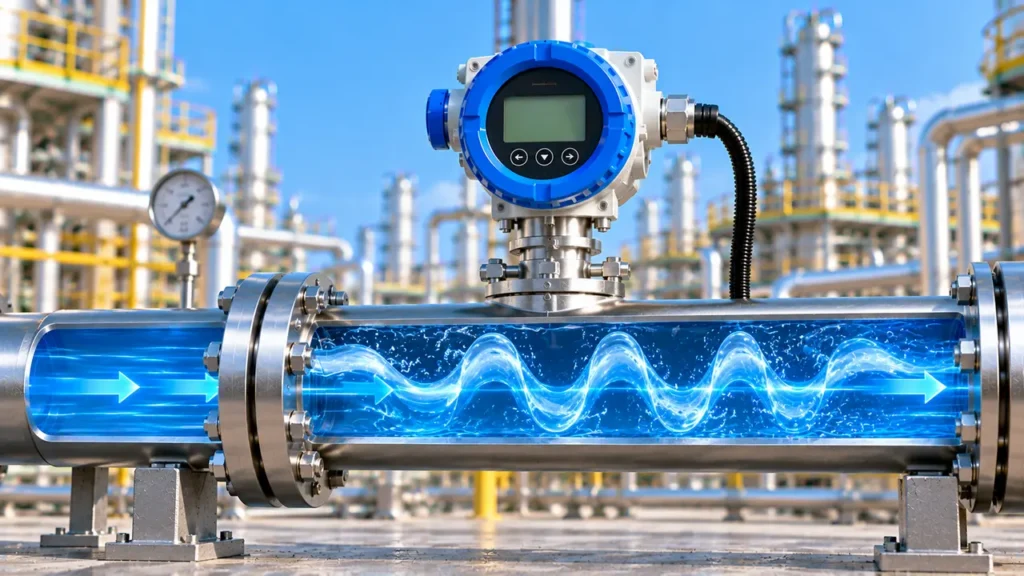
FLOW MEASUREMENT
Pulsating flow can create unstable measurement conditions in industrial piping, particularly when pumps, compressors or other cyclic equipment generate rapid changes in flow rate.
Understanding the causes, measurement effects and practical control methods helps engineers select and install flow meters for reliable pulsating service.
Pulsating Flow Measurement: Causes, Effects and How to Measure It
Pulsating flow measurement becomes important when fluid flow changes repeatedly instead of remaining relatively steady. These changes can occur over fractions of a second or over longer operating cycles, depending on the equipment producing the flow.
Reciprocating pumps, positive displacement pumps, compressors, dosing systems and cyclic process equipment are common sources of pulsation. If the pulsation is significant, it can influence the flow meter signal, displayed flow, totalized volume and control-system response.
In simple terms: A flow meter measures a changing process signal, but the measurement system may display an averaged, filtered or instantaneous value depending on the meter technology and signal processing.
What Is Pulsating Flow?
Pulsating flow is a condition in which flow rate varies periodically or irregularly around an average value. Instead of maintaining a nearly constant velocity through the pipe, the fluid accelerates and decelerates as the source produces successive flow pulses.
The difference between the minimum and maximum flow can be small or very large. The pulsation frequency can also vary significantly between applications.
Cyclic Equipment
→
Flow Variation
→
Meter Signal
→
Displayed / Totalized Flow
What Causes Pulsating Flow in Industrial Piping?
Reciprocating pumps
Reciprocating pumps move fluid through repeated mechanical strokes. Each stroke can create a distinct change in flow rate, producing a periodic flow pattern.
Positive displacement pumps
Gear, piston, diaphragm and other positive displacement pumps can generate pulsation depending on their construction, speed, number of chambers and operating conditions.
Reciprocating compressors
Gas flow from reciprocating compressors can contain significant pulsation because compression and discharge occur in repeated cycles.
Dosing and metering systems
Small dosing pumps may intentionally deliver fluid in repeated pulses. In chemical injection applications, the amplitude and frequency of these pulses can be important to the measurement system.
Fast control actions and cyclic processes
Rapid valve movement, batch operations and cyclic process equipment can also create temporary or repeating variations in flow.
How Does Pulsating Flow Affect Flow Measurement?
The effect depends on the amplitude and frequency of the pulsation, the meter technology, pipe arrangement and signal processing. A meter may respond differently to a rapidly changing flow than to a steady flow having the same average value.
| Condition | Possible measurement effect | Engineering consideration |
|---|---|---|
| Low amplitude pulsation | Small variation around average flow | Check whether the meter and transmitter filtering are adequate |
| High amplitude pulsation | Large instantaneous flow changes | Evaluate meter operating limits and upstream process behaviour |
| High frequency pulsation | Signal may contain rapid fluctuations | Review sampling, signal processing and damping |
| Low frequency pulsation | Large visible changes in indicated flow | Consider the required response time and averaging method |
Why Average Flow and Instantaneous Flow Are Different
For pulsating service, the average flow rate may be suitable for process reporting while the instantaneous flow rate may fluctuate substantially.
Average flow over a measurement interval
Qavg = V ÷ t
Qavg is average volumetric flow, V is accumulated volume and t is the measurement interval.
Worked Example
Suppose a process transfers 600 litres during a 5 minute interval.
Qavg = 600 ÷ 5
Average flow = 120 L/min
The actual flow may have repeatedly moved above and below 120 L/min during the five minute period. The average value alone does not describe the instantaneous pulsation.
Which Flow Meters Can Be Used for Pulsating Flow?
No single flow meter technology is automatically suitable for every pulsating application. The meter should be evaluated against the actual flow waveform, fluid properties, pulsation frequency, pressure and required measurement objective.
Coriolis Flow Meters
Coriolis meters can provide mass and density information, but the specific model's response to pulsating conditions and recommended installation should be checked with the manufacturer.
Electromagnetic Flow Meters
Electromagnetic meters can be considered for conductive liquids. Signal damping and the meter's specified operating conditions should be reviewed where flow changes rapidly.
Ultrasonic Flow Meters
Ultrasonic meters can be suitable for many liquid applications, but acoustic conditions, velocity profile and the manufacturer's pulsating-flow guidance should be evaluated.
Vortex Flow Meters
Vortex meters depend on vortex formation and frequency detection. Strong pulsation can influence the measured signal, so application-specific suitability should be verified.
Differential Pressure Flow Meters
Differential pressure measurement responds to changing pressure and flow conditions. Pulsation effects and transmitter response should be considered during system design.
Positive Displacement Meters
Positive displacement meters inherently measure discrete quantities of fluid and can be useful in suitable applications, but pressure, viscosity, pulsation frequency and mechanical limitations must be considered.
How to Reduce Pulsation Before the Flow Meter
Use a pulsation dampener
A correctly selected pulsation dampener can reduce flow variation by absorbing part of the pressure and flow fluctuation generated by reciprocating or positive displacement equipment.
Review pump operating conditions
Pump speed, stroke rate, number of cylinders and operating point can influence pulsation. Process equipment should be evaluated as part of the complete hydraulic system rather than treating the flow meter in isolation.
Use appropriate pipe volume and layout
Pipe geometry and fluid volume between the pulsation source and the meter can influence how the pulsation reaches the measuring point. The actual installation should follow the equipment manufacturer's recommendations.
Our tip: If a flow meter is showing large periodic fluctuations, do not immediately assume that the meter is faulty. First determine whether the process itself is generating a corresponding pulsating flow signal.
Flow Meter Signal Damping and Filtering
Many transmitters provide damping, averaging or signal filtering. These functions can make a displayed value easier to interpret when the process is naturally unstable.
However, filtering does not remove the physical pulsation in the pipe. It changes how the measurement signal is presented or processed.
Important: Excessive damping can make a display look stable while delaying the response to genuine process changes. Damping time should therefore be selected according to the control and measurement objective.
How to Measure Pulsation in a Flow System
A proper assessment starts by identifying both the average flow and the variation around that average. Depending on the application, engineers may use the flow meter's high-speed output, pressure measurements, data acquisition equipment or a suitable reference instrument.
Record the flow waveform
Where possible, capture the measurement signal at a sufficiently high sampling rate to reveal the repeating pattern. A slow trend can hide rapid pulsation.
Determine minimum and maximum flow
Identify the approximate minimum and maximum instantaneous flow and compare them with the meter's specified operating range.
Determine pulsation frequency
The frequency of the cyclic variation can help identify whether the source is related to pump strokes, compressor cycles, rotating equipment or another periodic process event.
Compare flow and pressure signals
In some applications, comparing flow and pressure trends can help identify whether the observed variation originates upstream of the meter or within the measurement system.
Pulsation Frequency and Sampling
Sampling requirements depend on the frequency and shape of the pulsation. If the measurement system samples too slowly, important variations can be missed or represented incorrectly.
Basic frequency relationship
f = 1 ÷ T
f is frequency in hertz and T is the period of one complete pulsation cycle in seconds.
Worked Example
If one complete flow pulsation cycle occurs every 0.20 seconds:
f = 1 ÷ 0.20
Pulsation frequency = 5 Hz
This means the flow variation repeats approximately five times per second.
Installation Considerations for Pulsating Flow Measurement
Installation requirements become particularly important when the process flow is unstable. The meter should be installed according to its manufacturer recommendations, with appropriate consideration of straight pipe, flow profile, pressure, vibration and nearby equipment.
Where possible, avoid placing the meter immediately adjacent to equipment that creates severe hydraulic disturbances unless the meter manufacturer specifically permits that arrangement.
Our Flow Meter Selection Guide can be used as a broader starting point when evaluating process conditions and meter technology.
Common Mistakes in Pulsating Flow Measurement
| Mistake | Why it can cause problems | Better approach |
|---|---|---|
| Assuming average flow represents the entire process | Large instantaneous variations may be hidden | Evaluate the complete flow waveform where required |
| Using excessive signal damping | Real process changes may appear delayed | Select damping based on the measurement objective |
| Ignoring pulsation source | The meter may be blamed for a process problem | Check pumps, compressors and cyclic equipment |
| Ignoring pulsation frequency | Fast signal changes may not be captured correctly | Review sampling and transmitter response |
| Installing without considering hydraulic disturbance | Meter performance can be affected | Follow the manufacturer's installation requirements |
Related Flow Measurement Considerations
For applications involving unstable flow, understanding the measurement technology is important. You can also review practical methods for measuring pulsating flow in industrial piping for additional application considerations.
For electromagnetic applications, see how electromagnetic flow meters work to understand the underlying measurement principle.
For ultrasonic applications, review how ultrasonic flow meters work and the factors that influence ultrasonic measurement.
For pulse-output applications, understanding flow meter K-factor calculations can also help when interpreting pulse-based flow signals.
Frequently Asked Questions
What is pulsating flow?
Pulsating flow is flow that repeatedly changes in rate rather than remaining approximately steady. The variation may be periodic or irregular depending on the process equipment.
What causes pulsating flow?
Common sources include reciprocating pumps, positive displacement pumps, reciprocating compressors, dosing pumps and cyclic process equipment.
Does pulsating flow affect flow meter accuracy?
It can. The effect depends on the amplitude and frequency of pulsation, the meter technology, installation and signal processing. The manufacturer's application guidance should be checked for the selected model.
Can signal damping solve pulsating flow?
Damping can smooth the displayed or transmitted measurement, but it does not physically remove pulsation from the process. A mechanical pulsation control method may be required when the hydraulic variation itself must be reduced.
How do you measure pulsation frequency?
Record the flow or pressure signal and determine the time between repeating cycles. Frequency can then be calculated using f = 1 ÷ T.
Should a pulsation dampener be installed before every flow meter?
No. The need depends on the process, pulsation severity, equipment and measurement requirements. The system should be evaluated before selecting a dampener.
Conclusion
Pulsating flow measurement requires engineers to consider both the average process flow and the instantaneous variation around that average. Pumps, compressors and cyclic equipment can generate significant pulsation, which may influence meter response and signal stability.
A reliable solution starts by identifying the pulsation source, understanding its amplitude and frequency, selecting a suitable flow meter and applying appropriate installation and signal-processing methods. Where the hydraulic pulsation itself is excessive, mechanical pulsation control may also be required.
SELECT THE RIGHT FLOW METER WITH OUR TEAM
Share your fluid, flow range, line size, pressure, temperature and pulsating-flow conditions. Our team can help evaluate suitable flow meter technologies and key application requirements.
Call: +971 52 942 7777
Email: info@kleevme.ae
Web: www.kleevme.ae
KLEEV Middle East FZE · P.O. Box 17259 · Plot M00767 · JAFZA (North), Dubai, UAE
44 Views