
FLOW MEASUREMENT
Flow Meter Turndown Ratio: Meaning, Calculation and Importance
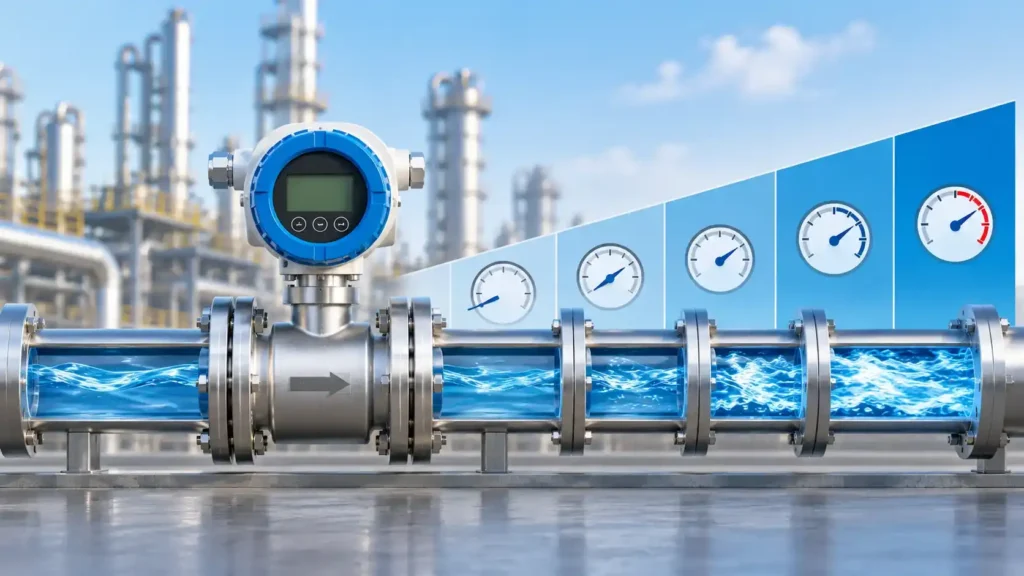
Flow meter turndown ratio describes the usable measurement range between the maximum and minimum flow rates at which a meter can maintain its specified performance.
Learn how to calculate turndown ratio, understand rangeability, see practical examples, and determine why turndown is important when selecting a flow meter for changing process conditions.
Flow Meter Turndown Ratio
Industrial processes rarely operate at exactly one constant flow rate. A pipeline may experience low flow during startup, normal flow during production and much higher flow during peak demand. A suitable flow meter must therefore be capable of measuring the expected operating range with the required performance.
This is where the flow meter turndown ratio becomes important. Turndown ratio indicates how wide a useful measurement range a flow meter can cover. It is commonly expressed as a ratio such as 10:1, 20:1, 50:1 or 100:1.
A higher turndown ratio can be useful when process flow varies significantly, but a high number alone does not automatically make one flow meter better than another. The stated accuracy, fluid properties, installation conditions and actual process flow range must also be considered.
What Is Flow Meter Turndown Ratio?
Flow meter turndown ratio is the ratio between the maximum and minimum flow rates over which the meter can provide its specified measurement performance.
In many instrumentation references, turndown ratio is also referred to as rangeability. The important point is that the minimum flow should represent a usable measurement limit under the stated performance conditions, not simply the lowest flow at which the instrument produces a signal.
In simple terms:
A flow meter with a 20:1 turndown ratio can cover a flow range where the maximum usable flow is 20 times the minimum usable flow, subject to the manufacturer's specified performance.
Example of a 20:1 Flow Range
Minimum: 5 m³/h
Maximum: 100 m³/h
Flow Meter Turndown Ratio Formula
The basic flow meter turndown ratio formula is straightforward:
Turndown Ratio Formula
TD = Qmax ÷ Qmin
Qmax = maximum usable flow |
Qmin = minimum usable flow
The result is normally written as a ratio, such as 10:1 or 50:1.
For flow measurement, however, the terms “maximum” and “minimum” should be interpreted carefully. The relevant limits are generally the flow values within which the meter meets the specified accuracy or other performance requirements. A meter may continue to indicate flow outside this range, but its published performance may no longer be guaranteed. :contentReference[oaicite:1]{index=1}
How to Calculate Flow Meter Turndown Ratio
Calculating the flow meter turndown ratio requires only the maximum and minimum usable flow rates.
Worked Example 1
Suppose an industrial flow meter is specified for:
- Maximum usable flow = 100 m³/h
- Minimum usable flow = 10 m³/h
Apply the formula:
TD = 100 ÷ 10
Turndown Ratio = 10:1
This means the meter has a usable flow range from 10 m³/h to 100 m³/h under the stated performance conditions.
Worked Example 2: Higher Turndown
Example:
Maximum usable flow = 500 m³/h
Minimum usable flow = 10 m³/h
TD = 500 ÷ 10
Turndown Ratio = 50:1
Compared with a 10:1 meter, the 50:1 meter can cover a much wider range between its specified maximum and minimum flow limits.
How to Calculate Minimum Flow From Turndown Ratio
The formula can also be rearranged when the required turndown ratio and maximum flow are known.
Minimum Flow Formula
Qmin = Qmax ÷ TD
Worked Example
A flow meter has a maximum usable flow of 200 m³/h and a turndown ratio of 20:1.
Qmin = 200 ÷ 20
Minimum Usable Flow = 10 m³/h
Process Flow Range vs Flow Meter Turndown
One of the most important concepts in flow meter selection is the difference between the process flow range and the meter's turndown ratio.
The process may require measurement from 8 m³/h to 100 m³/h. In that case, the process itself has a required range of:
Required Process Turndown
100 ÷ 8 = 12.5:1
Therefore, a meter needs to provide at least the required usable range under the specified measurement conditions. Selecting a meter with a nominal 10:1 turndown would not satisfy a 12.5:1 requirement if the stated limits are directly comparable.
KLEEV Tip:
Always calculate the process turndown before selecting the meter. Compare the required minimum and maximum process flows with the manufacturer's guaranteed measurement range and accuracy.
Why Is Flow Meter Turndown Ratio Important?
The importance of flow meter turndown depends largely on how much the process flow changes during normal operation.
Variable Flow
Processes with large changes between minimum and maximum flow can benefit from a meter with sufficient turndown.
Process Control
Maintaining reliable measurement across the operating range helps control systems respond to changing process conditions.
Energy Measurement
Applications such as steam, compressed air and water may experience significant changes in demand.
Did You Know?
A flow meter can have a large physical measurement range but a smaller effective turndown when the required accuracy is taken into account. Therefore, the advertised maximum and minimum values should always be read together with the accuracy specification.
Turndown Ratio and Flow Meter Accuracy
Flow meter accuracy and turndown ratio are closely related during meter selection. A manufacturer's turndown specification should be understood together with the accuracy that applies across that range.
For example, a specification may indicate one accuracy over a certain flow range and a different accuracy at lower flow rates. In such a case, quoting only the maximum possible range can give an incomplete picture of actual measurement performance.
This is especially important when comparing different flow meter technologies. The measurement principle, sensor design and signal processing can influence the usable low-flow range.
For more information on the relationship between measurement performance specifications, see our article: Flow Meter Accuracy vs Repeatability: What Is the Difference?
Flow Meter Rangeability vs Turndown Ratio
The terms rangeability and turndown ratio are frequently used interchangeably for flow meters. Both describe the width of the usable measurement range, commonly represented by the ratio of maximum to minimum flow.
However, the exact terminology can vary between manufacturers and industries. Therefore, when comparing flow meter datasheets, the numerical ratio should never be considered without checking how the manufacturer defines the measurement range and the associated accuracy.
| Term | Typical Meaning | What to Check |
|---|---|---|
| Turndown Ratio | Ratio between maximum and minimum usable flow. | Accuracy and specified operating conditions. |
| Rangeability | Ability to cover a defined flow range within specified performance limits. | Manufacturer's definition and guaranteed range. |
| Measuring Range | The flow interval over which the meter is specified to operate. | Minimum and maximum flow limits. |
| Accuracy | How close the indicated flow is to the reference value. | % of reading, % of full scale or other stated basis. |
Turndown Ratio of Different Flow Meter Technologies
Turndown capability varies between flow meter technologies and individual meter designs. There is therefore no single turndown ratio that applies to every meter of a particular type.
The following table should be treated as a general selection consideration rather than a universal specification. Always use the manufacturer's datasheet for the final value.
| Flow Meter Technology | Turndown Consideration | Typical Application Consideration |
|---|---|---|
| Magnetic Flow Meter | Can provide a useful range for conductive liquids, depending on meter design and velocity range. | Water, wastewater, chemicals and conductive process liquids. |
| Coriolis Flow Meter | Often provides a broad usable range, but actual performance depends on meter size and process conditions. | Mass flow, batching, chemicals and process fluids. |
| Ultrasonic Flow Meter | Range depends strongly on technology, installation and fluid conditions. | Water, utilities, process measurement and larger pipelines. |
| Vortex Flow Meter | Low-flow performance is influenced by velocity and vortex formation. | Steam, gases and clean liquids. |
| Differential Pressure Flow Meter | Low-flow performance is strongly linked to differential-pressure measurement and square-root extraction. | Steam, gases and liquid process measurement. |
What Happens When Flow Falls Below the Turndown Range?
When the process flow falls below the meter's specified minimum usable flow, the instrument may still display a value. However, the published accuracy or repeatability may no longer apply.
At very low flow, the measurement signal can become small compared with noise or other sources of uncertainty. The result can be increased measurement uncertainty or unstable readings.
This is why the minimum flow rate is just as important as the maximum flow rate during flow meter selection.
Important:
Never assume that a meter remains within its specified accuracy simply because its display continues to show a flow value below the published minimum range. Check the manufacturer's measurement range and performance specification.
How Flow Meter Oversizing Affects Turndown
Oversizing a flow meter can create problems when the normal process flow is much lower than the meter's designed operating range.
Consider a pipeline where normal flow is 20 m³/h but the selected meter is sized for a maximum usable flow of 500 m³/h. Even if the meter can physically accept the pipe flow, the normal operating point may be too low relative to its useful measurement range.
Correct meter sizing therefore requires more than matching the meter connection size to the pipeline. The minimum, normal and maximum flow rates should all be considered.
How to Select a Flow Meter With the Right Turndown Ratio
Start by defining the actual process flow envelope. Record the minimum expected flow, normal operating flow and maximum expected flow.
Then calculate the required process turndown:
Required Process Turndown
Required TD = Qmax process ÷ Qmin process
Once the required ratio is known, compare it with the manufacturer's specified turndown under the actual fluid and process conditions.
You should also evaluate accuracy, pressure drop, temperature, fluid properties, pipe size, installation requirements, output signal and maintenance requirements.
KLEEV's Flow Meter Selection Guide provides a broader approach to selecting the appropriate flow measurement technology.
Flow Meter Turndown Selection Checklist
| Parameter | What to Determine |
|---|---|
| Minimum flow | Lowest flow that must be measured accurately. |
| Normal flow | Typical operating point of the process. |
| Maximum flow | Highest expected process flow. |
| Required turndown | Maximum process flow divided by minimum process flow. |
| Accuracy | Required measurement accuracy across the operating range. |
| Fluid properties | Density, viscosity, conductivity, temperature, pressure and composition. |
| Installation | Pipe size, straight runs, flow profile and meter orientation. |
Industrial Applications Where Turndown Matters
Water and Wastewater
Water demand can vary significantly throughout a treatment or distribution process. A suitable meter must cover the expected operating range without sacrificing required measurement performance.
Read more about flow measurement in water and wastewater treatment plants .
Steam Measurement
Steam demand can change between startup, normal production and peak production. Turndown is therefore an important consideration when selecting a steam flow meter, together with pressure, temperature and steam quality.
Compressed Air
Compressed-air demand can fluctuate considerably depending on production requirements. A meter with an appropriate measurement range can provide more useful monitoring during both low-demand and high-demand periods.
Chemical Processing
Chemical dosing and process flows may vary according to production requirements. The flow meter must be selected for the actual process range and the chemical properties of the fluid.
Oil and Gas
Oil and gas applications can have demanding flow measurement requirements where accuracy, repeatability and operating range all need to be evaluated together.
Reliable flow measurement is also an important part of instrumentation used in refineries and process plants. See KLEEV's article on the role of instrumentation in refineries .
Common Flow Meter Turndown Mistakes
1. Looking Only at Maximum Flow
Selecting a meter based only on maximum flow can result in poor performance at low operating conditions. The minimum process flow is equally important.
2. Assuming a Higher Ratio Is Always Better
A higher turndown ratio can be useful, but the meter should still be suitable for the fluid, pipe size, pressure, temperature and required accuracy.
3. Ignoring the Accuracy Specification
A quoted turndown ratio has limited meaning without understanding the performance specification associated with that range.
4. Confusing Physical Range With Usable Range
A meter may physically respond outside its specified range. That does not mean that the published accuracy is guaranteed there.
5. Oversizing the Meter
Choosing a much larger meter simply because it matches the pipeline size or future maximum flow can place normal flow too close to the lower end of the useful measurement range.
Frequently Asked Questions
What is flow meter turndown ratio?
Flow meter turndown ratio is the ratio between the maximum and minimum usable flow rates over which a meter can provide its specified measurement performance. It is commonly expressed as a ratio such as 10:1 or 50:1.
How is flow meter turndown ratio calculated?
The basic calculation is maximum usable flow divided by minimum usable flow: TD = Qmax ÷ Qmin.
What does a 10:1 turndown ratio mean?
A 10:1 turndown ratio means the maximum usable flow is ten times the minimum usable flow under the stated performance conditions. For example, a range of 10 to 100 m³/h represents 10:1 turndown.
Is turndown ratio the same as rangeability?
The terms are frequently used interchangeably for flow meters. However, definitions can vary between manufacturers, so the datasheet should always be checked for the exact meaning and associated performance limits.
Why is high turndown important in flow measurement?
High turndown can be useful when process flow varies significantly. It allows one flow meter to cover a wider usable operating range while maintaining its specified performance.
Does a higher turndown ratio mean higher accuracy?
No. Turndown ratio describes the width of the usable measurement range. Accuracy describes how close the measurement is to the reference value. They are related during selection but are not the same specification.
What happens below the minimum flow of a flow meter?
The meter may continue to produce an output, but its published accuracy or repeatability may no longer be guaranteed. Always check the manufacturer's specified minimum measurement flow.
How much turndown ratio do I need?
Calculate the required process turndown by dividing the maximum expected process flow by the minimum expected process flow. Then select a meter whose specified usable range covers that requirement under the actual process conditions.
Conclusion
The flow meter turndown ratio is an important specification when process flow varies over a wide range. It indicates how far the meter can operate between its maximum and minimum usable flow rates while maintaining its specified measurement performance.
The basic calculation is simple: divide the maximum usable flow by the minimum usable flow. However, selecting the right meter requires more than comparing turndown numbers. Accuracy, repeatability, fluid properties, installation conditions and the actual process flow envelope must all be considered.
Before specifying a flow meter, calculate the required process turndown and compare it with the manufacturer's guaranteed measurement range. This approach helps ensure reliable measurement across both normal and changing operating conditions.
External Resources
Need Help Selecting the Right Flow Meter?
Share your minimum, normal and maximum flow rates along with the fluid, pipe size, operating pressure and temperature. KLEEV can help you select the appropriate flow meter technology, size and measurement range for your application.
We support flow measurement requirements for water, wastewater, oil and gas, chemical processing, utilities, steam, compressed air and other industrial applications.
KLEEV Middle East FZE · P.O. Box 17259 · Plot M00767 · JAFZA (North), Dubai, UAE
30 Views