
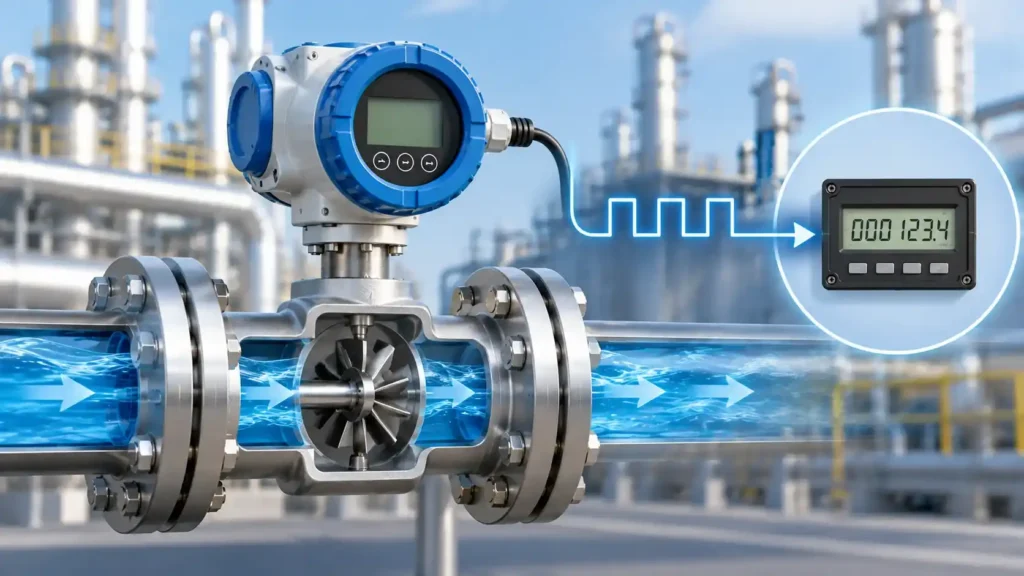
FLOW MEASUREMENT
A flow meter K-factor is a calibration constant that relates the pulses generated by a flow meter to the volume of fluid passing through it.
Learn what K-factor means, how to calculate it from pulse output, how it converts pulse frequency into flow rate, and why the correct K-factor is important for accurate flow measurement and totalization.
Many industrial flow meters provide a pulse or frequency output that represents the movement of fluid through the meter. To convert that electrical signal into a useful engineering value such as litres per minute, cubic metres per hour or gallons per minute, the measurement system needs a relationship between pulses and volume.
This relationship is commonly represented by the flow meter K-factor. It tells the flow computer, indicator, PLC or totalizer how many pulses correspond to a defined quantity of fluid.
Understanding the K-factor is important during flow meter commissioning, calibration, totalization and troubleshooting. It can also help engineers understand how a pulse-output flow meter converts a raw frequency signal into a meaningful flow measurement.
What Is Flow Meter K-Factor?
A flow meter K-factor is the number of output pulses generated for a defined unit volume of fluid passing through the meter.
It is commonly expressed as pulses per litre, pulses per cubic metre or pulses per gallon, depending on the meter and the measurement system.
Basic Definition
K = Pulses ÷ Volume
K = K-factor in pulses per unit volume
For example, if a flow meter generates 10,000 pulses while 100 litres of fluid pass through it, the K-factor is 100 pulses/L.
Worked Example
Pulses = 10,000
Volume = 100 L
K = 10,000 ÷ 100
K-factor = 100 pulses/L
How Does a K-Factor Work in a Flow Meter?
A pulse-output flow meter produces an electrical signal as fluid passes through the measuring element. The receiving instrument counts these pulses and uses the K-factor to convert them into flow rate or accumulated volume.
Fluid Flow
→
Flow Meter
→
Pulse / Frequency
→
K-Factor
→
Flow / Total
Turbine flow meters are a common example. Their rotor generates a pulse frequency related to flow, and the K-factor provides the relationship between those pulses and the measured volume.
For a deeper explanation of this application, see Turbine Flow Meter Working Principle, K-Factor, Straight Pipe Requirements and Calculator .
Why Is the K-Factor Important?
A pulse signal by itself does not tell a control system how much fluid has passed through the meter. The K-factor provides the scaling relationship needed to convert that signal into an engineering value.
Flow Rate
Pulse frequency can be converted into instantaneous volumetric flow.
Total Volume
Accumulated pulses can be converted into the total volume that has passed.
Commissioning
The K-factor can be checked when configuring PLCs, flow computers and totalizers.
Did You Know?
The K-factor is not necessarily a universal number for every meter of the same type. The applicable value can depend on the individual meter, calibration conditions and manufacturer's calibration data.
Flow Meter K-Factor Formula
The basic K-factor formula is:
K-Factor Formula
K = N ÷ V
N = number of pulses | V = measured volume
The units of the result depend on the volume unit used in the calculation. For example, if the volume is measured in litres, the result is pulses per litre.
How Is Flow Meter K-Factor Calculated?
To calculate a K-factor from a calibration or test, record the total number of pulses generated during a known volume of fluid and divide the pulse count by the measured volume.
Worked Example: K-Factor Calculation
A flow meter generates 25,000 pulses while 500 litres of fluid pass through the meter.
K = 25,000 ÷ 500
K-factor = 50 pulses/L
Therefore, every litre of fluid corresponds to approximately 50 pulses under the conditions represented by this calibration.
Interactive Flow Meter K-Factor Calculator
Enter the number of pulses and the measured volume to calculate the K-factor.
K-Factor Calculator
Calculate pulses per unit volume from a known pulse count and measured volume.
How to Calculate Flow Rate From K-Factor
Once the K-factor and pulse frequency are known, the volumetric flow rate can be calculated by dividing the pulse frequency by the K-factor.
Flow Rate Formula
Q = f ÷ K
Q = flow rate | f = pulse frequency | K = pulses per unit volume
When the K-factor is expressed in pulses per litre and the frequency is in pulses per second, the result is litres per second.
Worked Example: Pulse Frequency to Flow Rate
K-factor = 100 pulses/L
Pulse frequency = 25 Hz
Q = 25 ÷ 100 = 0.25 L/s
Convert to litres per minute:
0.25 × 60 = 15 L/min
Result: 15 L/min
InstrumentationBlog also explains this pulse-to-flow relationship in its Flow Meter K-Factor Explained: Formulas and Calculations article.
How Is Total Volume Calculated From K-Factor?
A totalizer can use the accumulated pulse count to determine the total volume that has passed through the meter.
Total Volume Formula
V = N ÷ K
V = total volume | N = total pulses | K = pulses per unit volume
Worked Example: Totalized Volume
Total pulse count = 50,000 pulses
K-factor = 100 pulses/L
V = 50,000 ÷ 100
Total volume = 500 L
Interactive Pulse-to-Flow Calculator
Use the calculator below when the K-factor is known and the pulse frequency needs to be converted into volumetric flow.
Pulse Frequency to Flow Rate
Enter pulse frequency and K-factor in pulses per litre.
Which Flow Meters Use a K-Factor?
K-factor concepts are particularly common with flow meters that provide pulse or frequency outputs. The exact implementation depends on the meter technology and transmitter configuration.
Turbine Flow Meters
Rotor movement produces a frequency signal related to fluid velocity. The calibrated K-factor converts the pulse frequency into volumetric flow.
Vortex Flow Meters
Vortex shedding creates a frequency signal that can be processed by the transmitter to determine flow.
Pulse-Output Meters
Pulse outputs can be counted by PLCs, flow computers and totalizers using the appropriate scaling factor.
How Is a Flow Meter K-Factor Determined?
The K-factor is generally established by comparing the meter's pulse output with a known reference volume or calibrated flow standard.
During a calibration test, the meter operates at a defined flow condition. The number of generated pulses is recorded and compared with the reference volume. The resulting relationship provides the applicable K-factor or calibration data.
Reference Volume
+
Pulse Count
→
K-Factor
→
Flow Computer
For a broader discussion of flow meter calibration, see 5 Proven Methods to Calibrate Flow Meters with Gases .
Single-Point vs Multi-Point K-Factor
A single K-factor can be sufficient when the meter's response is adequately represented by one calibration constant across the required operating range. However, some meters and applications may require multiple calibration points.
| Approach | How It Works | When It May Be Used |
|---|---|---|
| Single K-Factor | One calibration constant is used across the applicable operating range. | When the meter response is adequately represented by one value. |
| Multi-Point K-Factor | Different calibration values are associated with different flow points or operating ranges. | When meter response is non-linear or wide-range performance requires additional compensation. |
KLEEV Tip:
If the calibration certificate provides multiple K-factors or a calibration curve, use the manufacturer's recommended configuration instead of replacing the calibration data with an arbitrary average.
What Happens If the Wrong K-Factor Is Entered?
A wrong K-factor can produce a systematic error in the indicated flow and accumulated total. The physical pulse signal may be completely correct while the receiving instrument calculates the wrong engineering value.
Example: Incorrect K-Factor Configuration
Actual K-factor = 100 pulses/L
Pulse frequency = 20 Hz
Correct flow: 20 ÷ 100 = 0.20 L/s
If the receiving instrument is incorrectly programmed with 80 pulses/L:
Incorrect calculation: 20 ÷ 80 = 0.25 L/s
The configured K-factor would cause the indicated flow to be higher than the
value represented by the correct meter calibration.
Important:
During commissioning, verify the programmed K-factor against the applicable meter nameplate, calibration certificate or manufacturer documentation.
K-Factor Units and Conversion
The K-factor must always be interpreted together with its unit. A value expressed in pulses/L is not numerically interchangeable with pulses/m³.
| K-Factor | Meaning |
|---|---|
| 100 pulses/L | 100 pulses are generated for each litre. |
| 100,000 pulses/m³ | 100,000 pulses are generated for each cubic metre. |
| 400 pulses/US gal | 400 pulses are generated for each US gallon. |
Since 1 m³ equals 1,000 litres, a K-factor of 100 pulses/L corresponds to 100,000 pulses/m³.
Common Flow Meter K-Factor Problems
Wrong K-Factor Programmed
If the programmed value does not match the applicable meter calibration, the indicated flow and total can be consistently incorrect.
Incorrect Engineering Units
A K-factor must be entered using the correct volume basis. Always verify whether the meter documentation specifies litres, cubic metres, gallons or another unit.
Pulse Signal Problems
Missing pulses, electrical noise, incorrect signal conditioning or poor wiring can affect the calculated flow even when the K-factor itself is correct.
Calibration Data Not Considered
Some meters may have calibration information across several operating points. Using an unsuitable single value can reduce the accuracy of the resulting measurement.
Configuration After Transmitter Replacement
When a transmitter, totalizer or flow computer is replaced, the correct K-factor and scaling parameters should be transferred from the applicable instrument documentation.
Applications of K-Factor in Industrial Flow Measurement
Batching
K-factor scaling can be used to convert accumulated pulses into the quantity of liquid delivered during a batch.
Flow Totalization
Flow totalizers count pulses and use the K-factor to calculate accumulated volume. This is useful for monitoring production, consumption and material usage.
Process Control
A PLC, DCS or flow computer can use pulse frequency and K-factor to calculate instantaneous flow for process monitoring and control.
Fuel and Liquid Measurement
Pulse-output flow meters can provide a direct relationship between pulse count and measured volume in suitable liquid measurement applications.
Choosing and Evaluating Flow Meters
K-factor is only one part of a complete flow measurement system. Before selecting a meter, consider the required flow range, fluid properties, accuracy, installation conditions and output requirements.
KLEEV's Flow Meter Selection Guide provides a broader overview of the factors involved in flow meter selection.
The K-factor should also be considered alongside the usable measurement range. Read Flow Meter Turndown Ratio: Meaning, Calculation and Importance to understand how minimum and maximum usable flow affect meter selection.
Measurement performance is another important consideration. See Flow Meter Accuracy vs Repeatability: What Is the Difference? for a comparison of these two specifications.
For electromagnetic flow measurement, you can also read How Electromagnetic Flow Meters Work: Principles and Industrial Applications .
Frequently Asked Questions
What is a flow meter K-factor?
A flow meter K-factor is a calibration constant that commonly represents the number of output pulses generated for each unit of fluid volume passing through a meter. It is often expressed as pulses per litre, pulses per cubic metre or pulses per gallon.
What is the K-factor formula?
The basic K-factor formula is K = N ÷ V, where N is the number of pulses and V is the measured volume.
How do you calculate flow rate from K-factor?
Flow rate can be calculated using Q = f ÷ K, where f is pulse frequency and K is the K-factor. The units must be consistent.
How do you calculate total volume using K-factor?
Total volume can be calculated using V = N ÷ K, where N is the accumulated pulse count and K is pulses per unit volume.
Is the K-factor the same for every flow meter?
No. The applicable K-factor can depend on the individual meter and its calibration. The manufacturer's documentation or calibration certificate should be used when configuring the receiving instrument.
What happens if the wrong K-factor is programmed?
The calculated flow and total can be systematically incorrect even when the pulse signal itself is functioning correctly.
Can K-factor change with flow rate?
Depending on the flow meter technology and operating conditions, the relationship between pulse output and flow may not remain perfectly constant across the entire measuring range. Some applications therefore use multiple calibration points or linearization.
Where can I find the K-factor?
Depending on the flow meter, the K-factor may be provided on the nameplate, calibration certificate, datasheet or configuration documentation.
Conclusion
The flow meter K-factor provides the relationship between a pulse signal and the volume of fluid passing through a flow meter. It is widely used to convert pulse frequency into flow rate and accumulated pulses into total volume.
The basic calculation is simple: divide the number of pulses by the measured volume to obtain pulses per unit volume. Once the K-factor is known, pulse frequency can be divided by the K-factor to determine volumetric flow, provided the units are consistent.
In industrial applications, however, correct configuration is just as important as understanding the formula. Always verify the K-factor, engineering units, pulse scaling and applicable calibration information before commissioning a flow measurement system.
Need Help With Flow Meter Selection or Calibration?
Share your flow range, fluid properties, pipe size, output signal and application requirements. KLEEV can help you select the appropriate flow measurement technology and configuration for your process.
KLEEV Middle East FZE · P.O. Box 17259 · Plot M00767 · JAFZA (North), Dubai, UAE
28 Views