
Instrumentation Best Practices · KLEEV
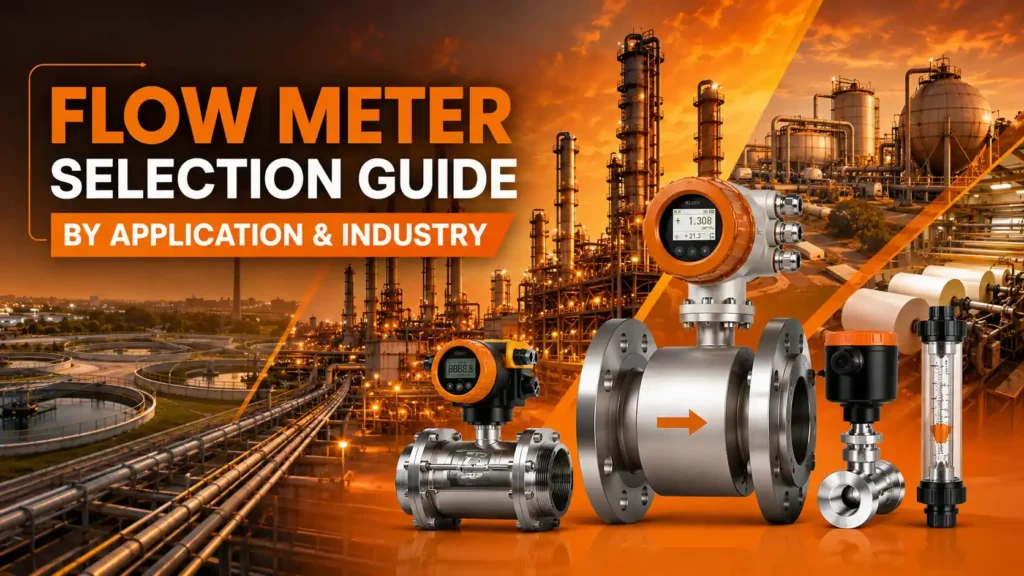
Flow Meter Selection Guide
How to match the right flow measurement technology to your fluid, your accuracy target and your industry, from oil and gas to water and steam.
Oil & GasWaterChemicalSteam & Utilities
There is no single best flow meter, only the best flow meter for a given job. A meter that is perfect for clean water in a treatment plant can be useless on saturated steam or a sticky crude oil emulsion. Getting flow meter selection right means starting from the fluid and the application, not from a favourite technology, and matching the physics of the meter to the reality of the process.
This guide takes an application and industry first approach. It walks through the main flow measurement technologies, the questions that drive a good choice, and which meters tend to win in each sector. It sits alongside the wider KLEEV instrumentation range across pressure, temperature, level and flow, so the meter you choose fits the rest of your measurement scheme.
01Why flow meter selection is never one size fits all
Flow is one of the most measured and most misjudged variables in a plant. The same pipe can be metered a dozen ways, and each technology reads a slightly different thing: some measure velocity, some measure volume, some measure true mass. A magnetic meter needs a conductive liquid and cannot see steam. A turbine meter loves clean fluids and hates grit. A Coriolis meter gives beautiful mass accuracy but costs more on large lines. This is why flow meter selection rewards a clear head about what the process actually is.
The cost of getting it wrong is rarely just a poor reading. An unsuitable meter can clog, wear out early, lose accuracy as the fluid changes, or force an expensive rework once the plant is running. Because the meter is usually welded or flanged into the line, a mistake is far harder to undo than it was to make. Time spent on flow meter selection at the design stage is some of the cheapest insurance on the whole project.
Start here
Describe the fluid before you name a meter. Is it liquid, gas or steam? Clean or dirty? Conductive? Viscous? Corrosive? How accurate must the reading be, and does it need mass or volume? Those answers decide the technology far more than brand or price.
02Match the meter to your fluid
The fastest way into flow meter selection is to let the fluid point you at a technology. Tap the condition that best fits your application to see a sensible starting choice and why it fits.
What are you measuring?
Electromagnetic flow meter
Clean or dirty conductive liquid
For water, wastewater and most water based chemicals, an electromagnetic meter is often the first choice. It has no moving parts and no obstruction, causes almost no pressure loss, and handles dirty and slurry flows well. The one firm rule is that the liquid must be electrically conductive, so it cannot meter hydrocarbons or steam.
03The main flow measurement technologies
Six technologies cover the great majority of industrial duties. Each has a clear home ground and a clear weakness, and knowing both is the heart of flow meter selection.
Differential pressure
An orifice plate, venturi or averaging pitot creates a pressure drop that a differential pressure transmitter converts to flow. The most widely used method in the world.
Best for: liquids, gases and steam on almost any line size.
Watch out: needs straight run, gives a permanent pressure loss, limited turndown.
Electromagnetic
A magnetic field across the pipe induces a voltage in the moving conductive liquid, proportional to velocity. No moving parts and a clear bore.
Best for: water, wastewater, slurries and conductive chemicals.
Watch out: only works on conductive liquids, never gas or steam.
Coriolis
The fluid passes through vibrating tubes and its inertia twists them by an amount proportional to mass flow. It reads true mass and density at once.
Best for: high accuracy, custody transfer, mass dosing, liquids and gases.
Watch out: higher cost and size on large lines.
Ultrasonic
Transit time meters compare sound pulses sent with and against the flow; Doppler versions read reflections from particles. Available inline or clamp on.
Best for: clean liquids, gas, large pipes and retrofits without cutting in.
Watch out: transit time needs reasonably clean fluid; installation affects accuracy.
Vortex
A bluff body sheds vortices whose frequency rises with velocity. Rugged, with no moving parts to wear.
Best for: steam, gas and low viscosity liquids in utilities and process.
Watch out: struggles at very low flow and with heavy vibration.
Turbine
A rotor spins in proportion to velocity and a pickup counts the blades. Accurate and repeatable on the right fluid.
Best for: clean, low viscosity liquids such as refined fuels and water.
Watch out: bearings wear, and solids or dirty fluid shorten its life.
No single line of this list is a verdict on its own. A vortex meter and a Coriolis meter might both suit a gas line, and the deciding factor could be accuracy, budget or available line size rather than the technology itself. The skill lies in reading each meter's strengths and weaknesses together and weighing them against what the application truly needs, which is where an experienced instrument supplier earns its keep.
04The questions that drive the choice
Behind every good decision is a short checklist. Working through these questions turns a vague requirement into a confident flow meter selection. Tap each factor to see what it decides.
Tap a factor ↓
1
Fluid
2
Fluid state
3
Accuracy
4
Size & range
5
Loss & cost
6
Site
Fluid and phase
Liquid, gas or steam is the first fork in the road. It rules whole technologies in or out before anything else: a magnetic meter for conductive liquid, a vortex or DP meter for steam, a thermal mass meter for low pressure gas.
05Flow meters by industry
Every sector has its own habits, driven by its fluids and its rules. Here is where each technology tends to earn its place, and it is often the quickest sanity check on a flow meter selection.
Oil & Gas
Custody transfer, allocation and wellhead metering on hydrocarbons and gas, often in hazardous areas.
Usual choice: Coriolis, ultrasonic, turbine, DP
Water & Wastewater
Abstraction, distribution and effluent, where fluids are conductive and often dirty.
Usual choice: Electromagnetic, ultrasonic
Chemical & Petrochemical
Corrosive, viscous and reactive fluids that demand accuracy and material compatibility.
Usual choice: Coriolis, electromagnetic, vortex
Power & Utilities
Steam, feedwater, gas and cooling water across boilers and turbines.
Usual choice: Vortex, DP, ultrasonic
Food, Beverage & Pharma
Hygienic duties needing clean bore, high accuracy and easy cleaning.
Usual choice: Coriolis, hygienic electromagnetic
HVAC & Buildings
Chilled and hot water for energy metering, where retrofit and low loss matter.
Usual choice: Ultrasonic, electromagnetic
These are starting points, not rules. Two plants in the same industry can land on different meters because their fluids, line sizes or accuracy targets differ, which is exactly why flow meter selection is worth doing carefully each time.
06Accuracy, turndown and installation realities
A meter only delivers its rated accuracy if it is installed the way it was designed to be. Most technologies need a length of straight pipe upstream and downstream so the flow profile is settled, and skimping on that straight run is one of the most common causes of poor readings in the field. Turndown, the span from minimum to maximum flow a meter can read accurately, also varies widely and should comfortably cover the real operating range rather than just the design point.
It also helps to separate accuracy from repeatability. A control loop often cares more that a reading is stable and repeatable than that it is absolutely correct, while a custody meter must be both. Modern meters add value here with built in diagnostics that can flag a blocked line, an empty pipe or a drifting signal, turning the meter into a source of health information as well as a flow reading.
Fluid first
Then technology
Mass or volume
Know which you need
Straight run
Respect the spec
Turndown
Cover the real range
Remember too that flow rarely lives alone. A flow reading is often paired with pressure and temperature to correct gas volumes to standard conditions, so a good flow meter selection considers the whole measurement together rather than the meter in isolation.
07Hazardous areas, standards and quality
On oil and gas and chemical sites the meter usually sits in a classified area, so it must carry the right explosion protection certification and, where electronics are involved, a suitable enclosure. Our guide to Ex proof enclosures explains the zone and marking system that any field instrument in a flammable atmosphere must respect.
Sound practice is anchored in standards. Differential pressure flow measurement with orifice plates follows the ISO 5167 series, water meters follow ISO 4064, and custody transfer in oil and gas follows measurement standards from bodies such as the API. Specifying to a recognised standard keeps a flow meter selection defensible and makes acceptance testing straightforward. For the physical installation, the same care described in our pressure gauge installation guide applies to isolation, access and commissioning.
None of this needs to be daunting. A short, structured conversation about the fluid, the accuracy target and the site usually settles the choice quickly, and a manufacturer who also makes the surrounding instrumentation can help match the meter to the pressure, temperature and enclosures around it, so the whole measurement point works as one.
08Frequently asked questions
Describe the fluid and the application before naming a technology. Whether the fluid is liquid, gas or steam, clean or dirty, conductive or not, and how accurate the reading must be will point you at the right family of meters.
For most duties a Coriolis meter offers the highest accuracy and a direct mass reading, which is why it is favoured for custody transfer and dosing. Ultrasonic and turbine meters can also reach custody grade accuracy on the right clean fluids.
The differential pressure method comes closest, handling liquids, gases and steam across a wide range of line sizes, which is a large part of why it remains so common. Even so, a dedicated technology usually performs better within its own home ground.
Bends and fittings disturb the flow profile, and most meters assume a settled profile to read accurately. Providing the specified straight run upstream and downstream, or fitting a flow conditioner, protects the accuracy you paid for.
09The bottom line
Good flow meter selection is a disciplined match between the process and the physics: start from the fluid, weigh accuracy and mass against volume, respect line size, turndown and pressure loss, and confirm the meter suits the industry and the area it will live in. Do that and the meter will earn its keep for years; skip it and no amount of clever electronics will fix a technology that was wrong from the start.
KLEEV manufactures and supplies process instrumentation across pressure, temperature, level and flow, engineered for the heat, dust and hazardous atmospheres of the Gulf and backed by approvals from major oil and gas operators.
Choose the right flow meter with KLEEV
Share your fluid, line size and accuracy target and our engineering team will recommend the right flow meter and instrumentation, built and tested in the UAE and approved for major oil and gas operators.
KLEEV Middle East FZE · P.O. Box 17259, Plot MO0767, JAFZA (North), Dubai, UAE
139 Views