
PRESSURE MEASUREMENT
Pressure measurement is essential for monitoring equipment, protecting process systems and maintaining stable industrial operations. Two of the most commonly used instruments are pressure gauges and pressure transmitters. Although both are used to measure pressure, they serve different purposes and provide information in very different ways.
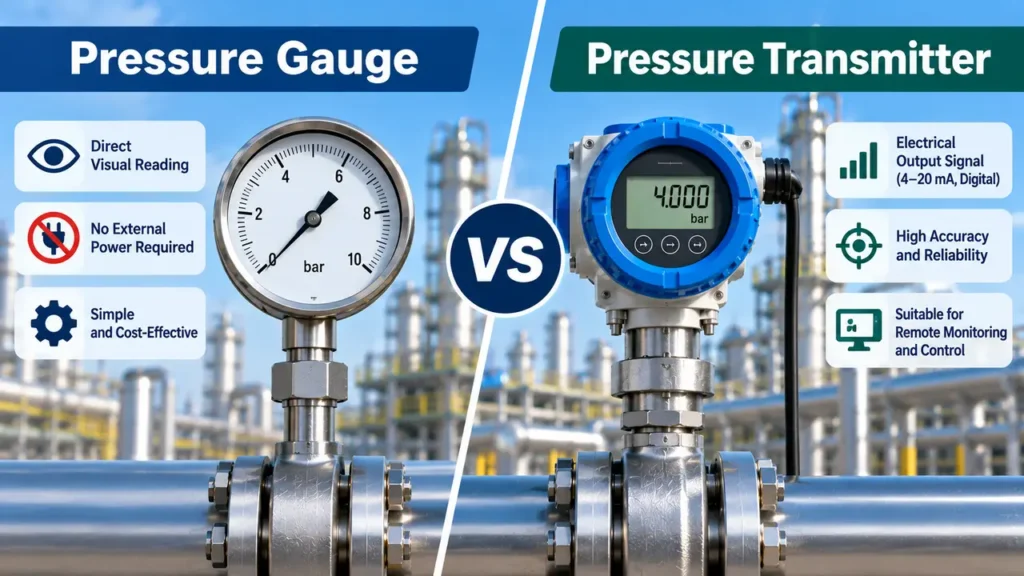
A pressure gauge provides a direct local indication that an operator can read at the instrument, while a pressure transmitter converts pressure into an electrical signal for remote monitoring, control and automation. The right choice depends on whether the application needs simple local indication, continuous measurement, integration with a PLC or DCS, or a combination of these functions.
Pressure Gauge vs Pressure Transmitter
Pressure Gauge vs Pressure Transmitter is an important comparison when selecting pressure instruments for industrial applications. A pressure gauge is primarily intended for local visual pressure indication, whereas a pressure transmitter provides a continuous electrical output that can be sent to a PLC, DCS, SCADA system or other control equipment.
Neither instrument is universally better. A gauge can be the most practical choice when an operator only needs to see the pressure locally. A transmitter becomes more suitable when pressure must be monitored remotely, recorded, alarmed or used as part of an automatic control strategy.
What Is a Pressure Gauge?
A pressure gauge is a mechanical or electronic instrument that displays pressure directly to an operator. Industrial mechanical gauges commonly use a sensing element such as a Bourdon tube, diaphragm or capsule to respond to pressure.
In a Bourdon tube gauge, process pressure enters a curved tube. As pressure increases, the tube tends to straighten. The resulting movement is transferred through a mechanical linkage to a pointer, which indicates the pressure on a graduated dial.
Because a traditional mechanical pressure gauge does not require an external electrical supply to indicate pressure, it can provide a simple and dependable local indication.
For more information about Bourdon tube construction and operation, see this guide to Bourdon tube pressure gauges .
What Is a Pressure Transmitter?
A pressure transmitter measures process pressure and converts the measurement into a standardized electrical signal. A common industrial output is 4–20 mA, which allows the measured pressure to be transmitted over wiring to a PLC, DCS or other control system.
Modern pressure transmitters can also provide digital communication and diagnostic information depending on the instrument design and communication protocol. This makes them suitable for applications where pressure information must be continuously monitored, displayed, recorded or used for automatic control.
Pressure transmitters are available in gauge, absolute and differential configurations. The correct pressure reference must therefore be selected according to the process requirement.
Read more about how to choose the right pressure transmitter for an application.
How Does a Pressure Gauge Work?
Process Pressure
→
Sensing Element
→
Mechanical Movement
→
Dial Indication
A mechanical pressure gauge converts pressure into physical movement. The sensing element responds to the pressure, and the resulting movement is transferred to the pointer mechanism.
The simplicity of this arrangement is one of the main reasons mechanical gauges remain widely used in pumps, compressors, pipelines, hydraulic systems and process equipment.
How Does a Pressure Transmitter Work?
Process Pressure
→
Sensor
→
Signal Processing
→
4–20 mA / Digital
A pressure transmitter uses a sensing element to detect pressure and electronics to convert the sensor response into a standardized output. The control system can then interpret this signal as a pressure measurement.
For example, a transmitter configured with a 0 to 10 bar range can normally represent the lower range value with 4 mA and the upper range value with 20 mA. The PLC or DCS can convert the signal into the corresponding pressure value for display, control and alarming.
Pressure Gauge vs Pressure Transmitter: Key Differences
| Parameter | Pressure Gauge | Pressure Transmitter |
|---|---|---|
| Primary purpose | Local pressure indication | Remote measurement and transmission |
| Indication | Dial or local display | Electrical signal and/or digital communication |
| Typical output | Visual indication | 4–20 mA, voltage or digital communication |
| Power requirement | Mechanical gauges generally require no electrical power | Requires electrical power |
| Remote monitoring | Not normally available | Yes |
| PLC/DCS integration | Not directly | Yes |
| Data logging | Not normally available | Yes, through the control or monitoring system |
| Complexity | Low | Higher |
| Typical use | Local monitoring | Monitoring, control and automation |
Pressure Gauge vs Pressure Transmitter: Accuracy
Accuracy depends on the specific instrument, range, calibration, installation and operating conditions. Therefore, it is not correct to assume that every pressure transmitter is automatically more accurate than every pressure gauge.
However, transmitters are generally preferred when pressure needs to be measured continuously and incorporated into an automated measurement or control system. Their electrical output also allows the signal to be processed, displayed and monitored remotely.
Mechanical gauges remain highly useful for direct local indication, especially where a simple visual reading is sufficient.
When Should You Use a Pressure Gauge?
A pressure gauge is usually a practical choice when the main requirement is to provide a direct local indication of pressure without integrating the instrument into an electronic control loop.
Local Monitoring
Use a gauge when operators need to walk up to the equipment and read pressure directly.
Simple Systems
A gauge can be appropriate where pressure measurement does not need PLC, DCS or SCADA integration.
Backup Indication
Gauges can provide local visual confirmation alongside electronic pressure measurement.
Common applications include pump discharge pressure, compressed-air systems, hydraulic equipment, utility lines, compressors and local process equipment.
When Should You Use a Pressure Transmitter?
A pressure transmitter is generally the better choice when pressure information must be available remotely or used as part of an automated process.
- Remote pressure monitoring from a control room.
- PLC, DCS or SCADA integration.
- Automatic pressure control.
- High and low pressure alarms.
- Continuous data logging and trending.
- Process optimization and performance monitoring.
- Applications requiring digital diagnostics or communication.
Pressure Gauge or Transmitter for a Pump?
Both instruments can be useful on pump systems. A local pressure gauge allows an operator to immediately see discharge or suction pressure at the equipment, while a pressure transmitter can send the measurement to the control system.
In many industrial installations, using both can provide complementary benefits: the transmitter supplies the remote measurement while the gauge provides a convenient local indication.
Practical Selection:
If the pump pressure only needs to be viewed locally, a gauge may be sufficient. If the pressure must control the pump, generate alarms or be monitored from a control room, a transmitter is usually more appropriate.
Pressure Gauge or Transmitter for a Compressor?
Compressor systems often benefit from local gauges because operators and maintenance personnel can quickly inspect pressure at the equipment. However, transmitters become important when pressure needs to be monitored continuously or incorporated into compressor control and protection logic.
The final selection should consider the compressor design, required control strategy, pressure range, pulsation, vibration and the required level of automation.
Pressure Gauge vs Pressure Transmitter for Process Plants
Process plants commonly require both local indication and centralized measurement. A pressure transmitter can provide the continuous process value required by the DCS or PLC, while a local gauge can allow field personnel to verify the pressure independently.
This combination can be particularly useful during commissioning, maintenance and troubleshooting because the field indication and control-system indication can be compared.
Advantages of a Pressure Gauge
- Simple construction.
- Easy local reading.
- Mechanical gauges generally operate without electrical power.
- Suitable for many general industrial pressure applications.
- Easy for field personnel to inspect.
- Can provide independent local indication.
- Available in many pressure ranges and materials.
For pressure gauge selection, range, accuracy, dial size, process connection, wetted material and environmental conditions should all be considered. See this pressure gauge selection guide for additional details.
Advantages of a Pressure Transmitter
- Provides continuous electrical pressure measurement.
- Supports remote monitoring.
- Can be integrated with PLC, DCS and SCADA systems.
- Suitable for automatic control loops.
- Supports pressure alarming and trending.
- Modern designs can provide diagnostics and digital communication.
- Available in gauge, absolute and differential configurations.
Limitations of a Pressure Gauge
A pressure gauge is mainly intended for local indication. It does not normally provide a direct electronic signal to the control system, which limits its use in automated applications.
Mechanical gauges can also be affected by vibration, pulsation, mechanical damage and installation conditions. Liquid-filled gauges or suitable accessories may be considered where vibration or pressure pulsation is significant.
Limitations of a Pressure Transmitter
A pressure transmitter requires electrical power and additional signal wiring or communication infrastructure. It is also more complex than a simple mechanical gauge and normally requires configuration and calibration.
The transmitter must also be correctly selected for pressure range, pressure reference, process temperature, wetted materials, environmental conditions and required output signal.
KLEEV Tip:
Do not select a pressure transmitter based only on pressure range. Always define whether the application requires gauge, absolute or differential pressure measurement and check the required output, process connection, materials and environmental conditions.
Can You Use Both a Pressure Gauge and Pressure Transmitter?
Yes. In many industrial applications, a pressure gauge and pressure transmitter can be installed together because they serve different purposes.
Process
→
Gauge
+
Transmitter
→
Local + Remote Monitoring
The gauge provides a direct field reference while the transmitter supplies the signal required by the control system. This arrangement can improve operational visibility and provide a convenient way to compare local and remote readings.
How to Choose Between a Pressure Gauge and Pressure Transmitter
| Application Requirement | Recommended Choice | Reason |
|---|---|---|
| Simple local pressure reading | Pressure Gauge | Direct visual indication is sufficient. |
| Remote monitoring | Pressure Transmitter | Provides an electrical measurement signal. |
| PLC or DCS integration | Pressure Transmitter | Can communicate the pressure measurement to the control system. |
| Automatic pressure control | Pressure Transmitter | Continuous measurement can be used by the control loop. |
| Independent local indication | Pressure Gauge | Provides direct field indication. |
| Local and remote measurement | Both | Each instrument serves a different function. |
| Trending and data logging | Pressure Transmitter | Signal can be recorded by the control or monitoring system. |
Pressure Gauge vs Pressure Transmitter: Selection Checklist
Before selecting the instrument, answer the following questions:
- Does the pressure need to be viewed only at the equipment?
- Does the measurement need to be sent to a PLC, DCS or SCADA system?
- Is automatic pressure control required?
- Is continuous trending or data logging required?
- What is the normal and maximum operating pressure?
- Is gauge, absolute or differential pressure required?
- What process temperature and fluid characteristics must the instrument handle?
- Will vibration or pulsation affect the measurement?
- What accuracy is required?
- Is a local gauge required as an independent field indication?
Pressure Gauge vs Pressure Transmitter: Final Decision
A Simple Decision Approach
Choose a pressure gauge when the main requirement is a simple, direct and local pressure indication.
Choose a pressure transmitter when pressure must be continuously measured, transmitted to a control system, monitored remotely, recorded or used for automatic control.
Choose both when the application benefits from centralized electronic measurement as well as independent local indication.
Conclusion
The choice between a pressure gauge and a pressure transmitter depends mainly on how the pressure measurement will be used. A pressure gauge provides a straightforward local indication and remains an effective solution for many industrial applications. A pressure transmitter provides a continuous electrical signal that can be integrated with PLC, DCS and SCADA systems for remote monitoring, alarming, trending and process control.
For simple field observation, a pressure gauge may be all that is required. For automated processes and centralized monitoring, a pressure transmitter is generally the more suitable instrument. In many process plants, using both provides the best combination of local visibility and remote measurement.
The final selection should always consider pressure range, measurement type, accuracy, process conditions, installation environment and the requirements of the control system.
Need Help With Pressure Measurement?
Share your pressure range, process fluid, operating temperature and application requirements. Our team can help you identify a suitable pressure gauge or pressure transmitter for your application.
KLEEV Middle East FZE · P.O. Box 17259 · Plot M00767 · JAFZA (North), Dubai, UAE
20 Views