
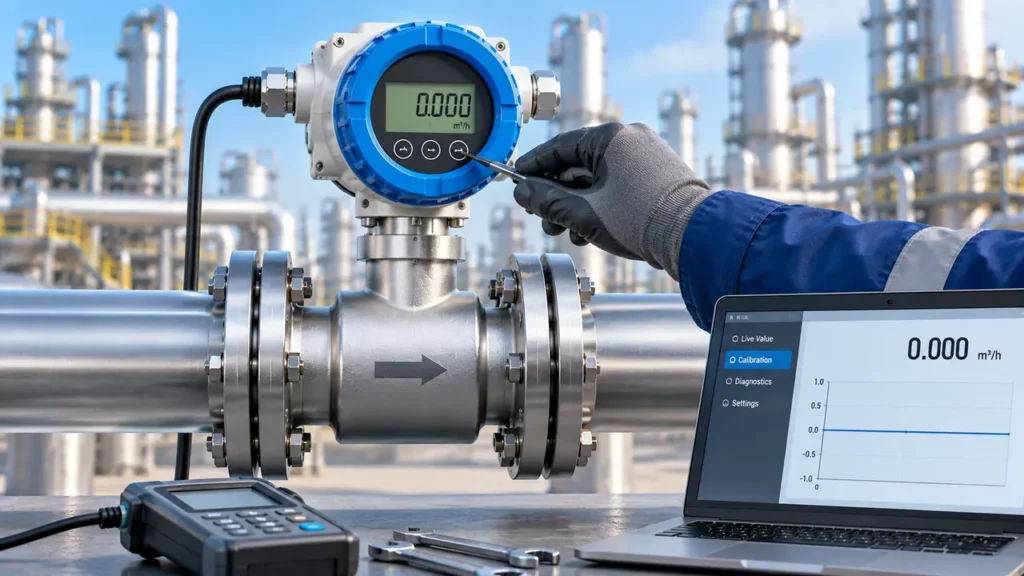
FLOW MEASUREMENT
A correct zero point is essential for reliable flow measurement. When a flow meter shows flow even though the process is stopped, the instrument may require zero verification or adjustment.
Understanding the causes of zero error and following the correct zero calibration procedure can help improve measurement stability and prevent unnecessary troubleshooting.
Flow Meter Zero Calibration
Flow Meter Zero Calibration establishes the meter's zero reference when there is no actual process flow. A correct zero allows the instrument to distinguish between a genuine flow signal and an offset in the measurement system.
What Is Flow Meter Zero Calibration?
Zero calibration is the process of adjusting or verifying the flow meter output when the actual flow through the measuring section is zero.
Depending on the flow meter technology, zero adjustment may compensate for small sensor or transmitter offsets that would otherwise appear as flow when the process is stationary.
Key Point:
Zero calibration should only be performed when the manufacturer specifies that the meter supports the procedure and when a true no-flow condition has been established.
Why Is Zero Calibration Important?
A zero offset can be particularly noticeable at low flow rates. Even a small zero error can represent a significant percentage of the actual measurement when the process operates near the lower end of the meter's range.
Correct zero adjustment can therefore improve low-flow measurement and prevent a stationary process from appearing to have continuous flow.
Accuracy
Reduces measurement offset when the meter should indicate zero flow.
Stability
Helps prevent unnecessary flow indication when the process is stopped.
Low Flow
A correct zero is especially important when measuring near the lower operating limit.
What Causes Flow Meter Zero Error?
A non-zero reading does not automatically mean that the meter needs calibration. Several process, installation and instrument conditions can produce an apparent zero-flow error.
- Actual flow is still present.
- Valve leakage allows fluid to pass through the meter.
- Air bubbles or gas are present in a liquid line.
- Temperature changes affect the measurement system.
- Mechanical or electrical noise affects the signal.
- The meter has an electronic zero offset.
- Incorrect installation affects the measurement.
- Process pressure or density changes influence the measurement.
- The meter has not reached stable operating conditions.
Flow Meter Zero Calibration Procedure
The exact procedure varies by flow meter technology and manufacturer. However, a typical zero verification and adjustment sequence includes establishing a genuine no-flow condition, allowing the instrument to stabilize and then using the meter's zero function if adjustment is required.
Stop Flow
→
Stabilize
→
Verify Zero
→
Adjust if Required
- Stop the process flow through the meter.
- Confirm that the measuring pipe or sensing section is in the required condition.
- Close valves as required to establish a genuine no-flow condition.
- Allow the meter and process conditions to stabilize.
- Observe the indicated flow at zero process flow.
- Use the manufacturer's zero-calibration function if adjustment is necessary.
- Verify that the meter returns to the expected zero indication.
- Restore normal process flow and confirm normal measurement operation.
Important:
Never perform a zero adjustment simply because the display shows a small flow value. First confirm that there is genuinely no flow through the meter.
How to Establish a True Zero-Flow Condition
Establishing zero flow is one of the most important parts of the procedure. Closing one valve may not be sufficient if fluid can continue to pass through another path.
Depending on the piping arrangement, zero flow may require isolating the meter section or closing suitable upstream and downstream valves while following the plant's safety and operating procedures.
KLEEV Tip:
Check for valve leakage, bypass flow and other alternate flow paths before starting zero calibration. A meter cannot be correctly zeroed while fluid is still moving through the measuring section.
Zero Calibration for Electromagnetic Flow Meters
Electromagnetic flow meters can require zero verification under appropriate no-flow conditions. The sensor must be correctly installed and the pipe should remain filled according to the manufacturer's requirements.
If an electromagnetic meter indicates flow when the process is stopped, first check for actual flow, pipe conditions, grounding and installation issues before performing a zero adjustment.
Our article on how electromagnetic flow meters work provides additional information about this measurement technology.
Zero Calibration for Coriolis Flow Meters
Zero stability is particularly important for Coriolis flow meters because the instrument measures mass flow and can be affected by changes in installation and process conditions.
A Coriolis meter's zero procedure normally requires the flow to be completely stopped while the measuring tubes remain filled under the required process conditions.
Temperature, pressure, installation stress and process stability should be considered before performing a zero adjustment.
Zero Calibration for Differential Pressure Flow Meters
Differential pressure flow systems use the pressure difference across a primary element to calculate flow. At zero flow, the differential pressure transmitter should provide the appropriate zero reference for the installation.
Zeroing a differential pressure transmitter should be performed only under the conditions specified for the particular installation. Equalizing the pressure across the transmitter may be necessary depending on the impulse piping and measurement arrangement.
Zero Calibration vs Span Calibration
| Parameter | Zero Calibration | Span Calibration |
|---|---|---|
| Purpose | Establishes the correct zero reference | Checks or adjusts response at a defined measurement point |
| Typical condition | No flow | Known reference input or calibration condition |
| Main concern | Offset | Measurement scale or sensitivity |
| Importance | Especially important at low flow | Important across the measurement range |
Why Does a Flow Meter Show Flow at Zero Flow?
A small indication at zero process flow can have several causes. Before recalibrating the meter, troubleshoot the process and installation first.
| Possible Cause | What to Check |
|---|---|
| Actual flow | Verify valves, pumps and bypass lines. |
| Valve leakage | Check whether fluid is passing through the isolated section. |
| Air or gas | Check liquid-filled conditions and possible air accumulation. |
| Electrical noise | Check wiring, grounding and signal interference. |
| Temperature changes | Allow the instrument and process to stabilize. |
| Installation problem | Verify meter orientation, piping and installation requirements. |
| Zero offset | Perform the manufacturer's zero verification procedure. |
Flow Meter Zero Calibration Troubleshooting
If the meter continues to show flow after a zero adjustment, investigate the cause rather than repeatedly changing the zero value.
Confirm No Flow
→
Check Installation
→
Check Signal
→
Verify Zero
1. Confirm the Process Is Actually at Zero Flow
Check pumps, valves, bypasses and other possible flow paths. A small amount of leakage can produce a real flow signal.
2. Check Pipe Conditions
For liquid meters, verify that the pipe remains properly filled and that air is not accumulating around the measuring section.
3. Check Electrical Conditions
Inspect wiring, grounding, shielding and the signal environment where applicable. Electrical interference can sometimes appear as unstable measurement.
4. Allow the Meter to Stabilize
Temperature changes, pressure changes and process transients can affect the indication. Allow the instrument to reach stable conditions before judging the zero point.
5. Perform Zero Adjustment Only When Required
If the meter remains outside its specified zero condition after the process and installation checks, follow the manufacturer's zero-calibration procedure.
Common Flow Meter Zero Calibration Mistakes
- Performing zero calibration while flow is still present.
- Ignoring valve leakage.
- Ignoring bypass flow.
- Performing repeated zero adjustments to hide an installation problem.
- Ignoring air in liquid applications.
- Performing calibration before process conditions stabilize.
- Using a generic procedure instead of the manufacturer's procedure.
- Confusing zero adjustment with complete meter calibration.
Did You Know?
Zero adjustment corrects the measurement reference at no flow. It does not automatically verify the complete accuracy of the flow meter across its operating range.
How Often Should Flow Meter Zero Calibration Be Performed?
There is no single interval that applies to every flow meter. Zero verification frequency depends on the meter technology, process conditions, required accuracy, installation and manufacturer's recommendations.
Zero checks may be appropriate during commissioning, after maintenance, following significant process changes or when the instrument shows unexpected zero behaviour.
A periodic calibration program should be based on the requirements of the application rather than using an arbitrary interval for every instrument.
Zero Calibration and Flow Meter Accuracy
A correct zero is one part of overall measurement performance. Accuracy can also be influenced by flow range, installation, fluid properties, temperature, pressure and calibration condition.
Our article on flow meter accuracy and repeatability explains other factors that affect reliable flow measurement.
Flow Meter Zero Calibration Checklist
| Check | Requirement |
|---|---|
| No-flow condition | Confirm that there is genuinely no flow through the measuring section. |
| Valve condition | Check for leakage and unintended flow paths. |
| Pipe condition | Verify the required filled or process condition. |
| Process stability | Allow pressure and temperature to stabilize where necessary. |
| Installation | Check orientation, piping and installation requirements. |
| Electrical signal | Check wiring, grounding and signal integrity where applicable. |
| Zero adjustment | Follow the manufacturer's specific zero procedure. |
| Final verification | Restore flow and confirm normal measurement operation. |
Conclusion
Flow Meter Zero Calibration establishes the correct measurement reference when there is no actual flow. It can be important for stable and accurate low-flow measurement, but zero adjustment should not be used as the first response to every zero-reading problem.
Always confirm a genuine no-flow condition, check the piping and installation, allow the process to stabilize and follow the manufacturer's procedure before making an adjustment.
Correct zero calibration, combined with proper installation and periodic verification, helps maintain reliable flow measurement throughout the meter's operating range.
Need Help With Flow Measurement?
Share your flow meter type, fluid, flow range and operating conditions. Our team can help identify zero-offset issues and suitable flow measurement solutions for your application.
KLEEV Middle East FZE · P.O. Box 17259 · Plot M00767 · JAFZA (North), Dubai, UAE
25 Views