
FLOW MEASUREMENT
A flow meter can show the instantaneous flow rate, but many industrial applications also need to know how much fluid has passed through the system over a period of time.
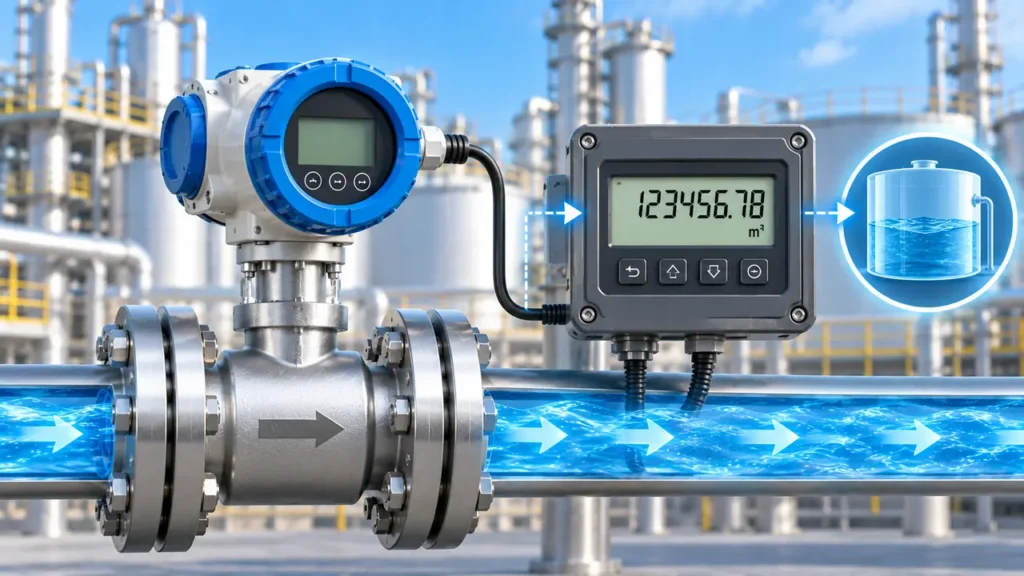
A flow totalizer performs this accumulation by converting flow measurements into a continuously increasing total quantity.
Flow Totalizer
A Flow Totalizer calculates and displays the accumulated quantity of fluid that has passed through a flow measurement system. It uses the flow rate signal from a meter and adds the measured quantity over time.
What Is a Flow Totalizer?
A flow totalizer is an instrument or function that accumulates flow over time. While a flow meter may indicate the current flow rate in m³/h, L/min or another unit, the totalizer calculates the corresponding accumulated quantity in units such as m³, litres or kg.
Key Point:
Flow rate tells you how fast fluid is moving, while a flow totalizer tells you how much fluid has passed during a specified period.
How Does a Flow Totalizer Work?
The basic operation is straightforward. The flow meter continuously provides a flow-rate signal, and the totalizer accumulates that flow according to the measurement time.
Flow Meter
→
Flow Signal
→
Totalizer
→
Accumulated Flow
The totalizer repeatedly adds the measured quantity during each time interval. When the flow rate changes, the amount added during each interval also changes.
Flow Rate vs Totalized Flow
| Parameter | Flow Rate | Totalized Flow |
|---|---|---|
| Meaning | Current rate of fluid movement | Accumulated quantity of fluid |
| Typical units | m³/h, L/min, kg/h | m³, L, kg |
| Value changes | Changes as process flow changes | Normally increases while flow is present |
| Main use | Monitoring and control | Consumption, batching and production quantity |
Flow Totalizer Formula
For a constant flow rate, accumulated volume can be calculated by multiplying the flow rate by the elapsed time.
Total Flow Formula
Total Flow = Flow Rate × Time
Ensure that the flow-rate and time units are compatible.
For variable flow, the totalizer performs the equivalent accumulation over successive measurement intervals rather than relying on one constant flow value.
Flow Totalizer Calculation Example
Example: Constant Flow
A flow meter measures water at 50 m³/h for 4 hours.
Total Flow = 50 × 4
Total Flow = 200 m³
Therefore, the totalizer should accumulate approximately 200 m³ during those four hours, assuming the flow remains constant.
How a Totalizer Handles Variable Flow
Industrial flow is often variable rather than constant. A totalizer therefore accumulates the flow continuously as the measured flow rate changes.
Example: Variable Flow
Assume a process operates at:
- 40 m³/h for 2 hours
- 60 m³/h for 3 hours
- 30 m³/h for 1 hour
Total volume:
(40 × 2) + (60 × 3) + (30 × 1)
Total Flow = 290 m³
Pulse-Based Flow Totalization
Many flow meters provide pulse outputs that can be used for totalization. Each pulse represents a defined quantity of fluid according to the meter's configured K-Factor or pulse scaling.
The totalizer counts the incoming pulses and converts the accumulated pulse count into the corresponding quantity.
Pulse Totalization
Total Volume = Number of Pulses ÷ K-Factor
The exact calculation depends on the K-Factor units and configuration.
For more information about K-Factors and pulse-based flow measurement, see Flow Meter K-Factor Calculations on InstrumentationBlog.
4–20 mA Flow Totalization
A totalizer can also calculate accumulated flow from a 4–20 mA signal. In this arrangement, the receiving device converts the analog current into a flow-rate value and integrates that value over time.
4–20 mA
→
Flow Rate
→
Integration
→
Total Flow
This function may be performed inside a dedicated flow totalizer, PLC, DCS, flow computer or other compatible control-system device.
Learn more about analog flow signals in our article: Flow Meter Signal Outputs .
Flow Totalizer in a PLC or DCS
A dedicated totalizer is not always required. A PLC or DCS can receive the flow signal, convert it into an engineering value and calculate the accumulated flow using its own software.
The choice depends on the application, control-system architecture, required accuracy, reporting requirements and available instrumentation.
Dedicated Totalizer
Provides a dedicated display and accumulation function for flow measurement applications.
PLC
Can calculate total flow as part of a wider automation and control application.
DCS
Can integrate totalized flow with process monitoring, alarms, trends and plant reporting.
What Is a Flow Totalizer Used For?
Flow totalizers are used whenever the accumulated quantity of fluid is more important than the instantaneous flow rate alone.
- Water consumption monitoring
- Fuel measurement
- Chemical dosing
- Batch processing
- Production quantity measurement
- Utility monitoring
- Custody and inventory applications
- Wastewater flow monitoring
Flow Totalizer for Water and Wastewater
Water and wastewater systems commonly require both instantaneous flow and accumulated volume. The instantaneous value can be used for process control, while the totalized value can support consumption reporting and operational analysis.
Proper meter installation and accurate flow measurement are important because any measurement error can accumulate over time.
See our article on flow measurement in water and wastewater treatment plants for additional application considerations.
Flow Totalizer Reset Function
Many totalizers provide a resettable total in addition to a continuously accumulated or non-resettable total. The resettable value can be useful for tracking daily, batch or shift consumption.
| Total Type | Purpose |
|---|---|
| Resettable Total | Used for batches, shifts, daily consumption or temporary monitoring. |
| Non-Resettable Total | Maintains an accumulated quantity for longer-term tracking. |
| Batch Total | Records the quantity associated with a specific batch or transfer. |
Common Flow Totalizer Problems
Incorrect totalized values can result from problems with the flow signal, scaling, pulse configuration or totalizer settings.
- Incorrect flow-meter scaling
- Wrong K-Factor
- Incorrect engineering units
- Incorrect pulse configuration
- Incorrect 4–20 mA range settings
- Loss of pulses
- Incorrect integration time
- Incorrect reset configuration
- Flow measurement errors
Important:
A totalizer cannot correct an inaccurate flow measurement. If the flow meter produces an incorrect flow signal, the accumulated total will also be incorrect.
How to Improve Flow Totalizer Accuracy
Totalized accuracy depends on the quality of the underlying flow measurement and the correct configuration of the accumulation system.
- Select a flow meter suitable for the application.
- Use the correct measuring range.
- Verify the flow meter calibration.
- Configure the correct K-Factor or analog scaling.
- Use consistent engineering units.
- Verify pulse detection where pulse outputs are used.
- Check totalizer configuration during commissioning.
- Periodically compare the total with a trusted reference where required.
For additional information about measurement performance, see Flow Meter Accuracy and Repeatability .
Flow Totalizer vs Flow Meter
| Feature | Flow Meter | Flow Totalizer |
|---|---|---|
| Primary function | Measures flow | Accumulates measured flow |
| Typical output | Flow rate signal | Totalized quantity |
| Typical units | m³/h, L/min, kg/h | m³, L, kg |
| Can operate independently? | Yes, depending on meter type | Requires a flow signal or integrated flow measurement function |
Flow Totalizer Selection Checklist
| Parameter | What to Check |
|---|---|
| Input signal | Confirm compatibility with 4–20 mA, pulse, frequency or digital output. |
| Flow units | Verify the required rate and totalized engineering units. |
| Flow range | Confirm minimum, normal and maximum flow values. |
| Pulse scaling | Verify the correct K-Factor when using pulse signals. |
| Reset function | Determine whether daily, batch or resettable totals are required. |
| Display | Check whether local indication of rate and total is required. |
| Control system | Confirm PLC, DCS or SCADA compatibility. |
Conclusion
A Flow Totalizer converts flow-rate information into an accumulated quantity by continuously adding the measured flow over time. It can receive signals such as 4–20 mA, pulse or frequency from a flow meter.
Totalized flow is useful for consumption monitoring, batching, production measurement and utility management. Accurate totalization depends on correct flow-meter measurement, signal scaling, K-Factor configuration and engineering units.
Selecting the right totalization method therefore requires considering both the flow meter output and the requirements of the receiving control or monitoring system.
Need Help With Flow Measurement?
Share your fluid type, flow range, process conditions and totalization requirements. Our team can help you select a suitable flow meter and measurement solution for your application.
KLEEV Middle East FZE · P.O. Box 17259 · Plot M00767 · JAFZA (North), Dubai, UAE
17 Views