
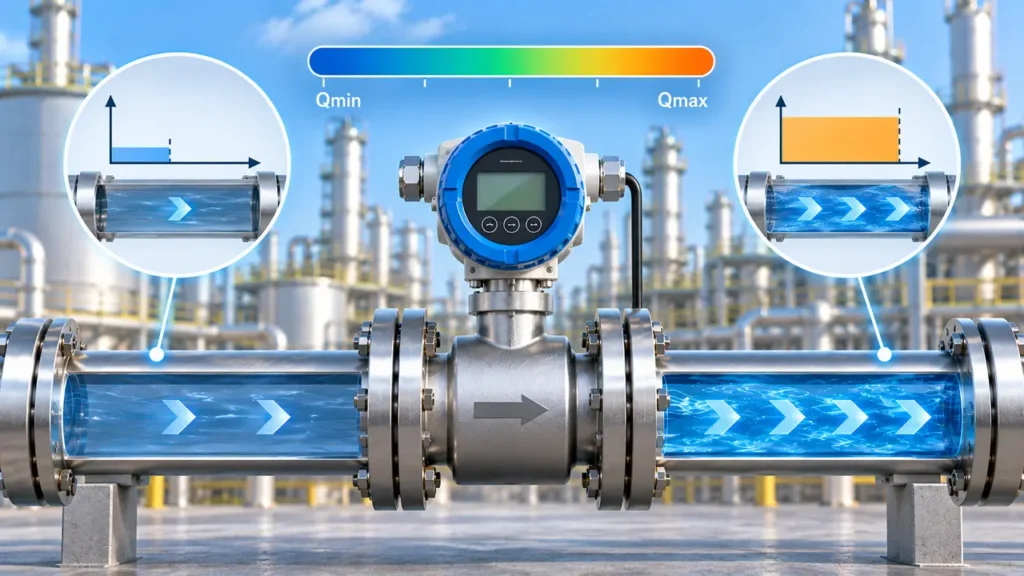
FLOW MEASUREMENT
Choosing the correct measuring range is essential for reliable flow measurement. A meter must cover both the normal operating flow and the lowest and highest conditions expected in the process.
Understanding rangeability and turndown helps prevent poor low-flow performance, over-ranging and unnecessary loss of measurement accuracy.
Flow Meter Rangeability
Flow Meter Rangeability describes how wide a flow range a meter can measure while maintaining its specified performance. Selecting the correct range requires looking at minimum, normal and maximum process flow rather than sizing the meter only for the expected average flow.
What Is Flow Meter Rangeability?
Rangeability, often expressed as a turndown ratio, is the ratio between the maximum flow and the minimum flow that the meter can measure within its specified operating or accuracy limits.
Rangeability Formula
Rangeability = Maximum Reliable Flow ÷ Minimum Reliable Flow
Both flow values must be within the meter's specified performance limits.
Example: Calculating Rangeability
Suppose a flow meter can accurately measure from 10 m³/h to 100 m³/h.
Rangeability = 100 ÷ 10
Rangeability = 10:1
This means the meter has a usable measuring range of ten times between its maximum and minimum specified flow.
Why Flow Meter Rangeability Matters
Industrial processes rarely operate at exactly one constant flow rate. Flow can change during startup, shutdown, production changes, batch operations, seasonal demand and part-load conditions.
A meter selected only around the normal flow may not perform correctly when the process moves significantly below or above that point.
Key Point:
The correct flow meter range should cover the actual process operating envelope, not simply the nominal or average flow rate.
Minimum, Normal and Maximum Flow
The first step in selecting a measuring range is to identify three important process values: minimum flow, normal flow and maximum expected flow.
Minimum Flow
The lowest flow that the process is expected to produce during normal operation, startup or low-load conditions.
Normal Flow
The flow rate at which the process operates most frequently. This is often the most important point for overall measurement performance.
Maximum Flow
The highest expected continuous or process flow that the meter must measure without over-ranging.
Minimum Flow
→
Normal Flow
→
Maximum Flow
How to Select the Correct Measuring Range
Measuring range selection should begin with actual process data. If the minimum and maximum flow values are known, the required rangeability can be estimated before comparing meter technologies.
- Determine the minimum process flow.
- Determine the normal operating flow.
- Determine the maximum expected flow.
- Calculate the required turndown ratio.
- Check the meter's minimum and maximum specified flow.
- Check accuracy across the complete operating range.
- Confirm pressure, temperature and fluid-property limits.
Required Turndown
Required Turndown = Maximum Process Flow ÷ Minimum Process Flow
Worked Example: Selecting a Flow Meter Range
Process Flow Range
Consider a process with:
- Minimum flow = 20 m³/h
- Normal flow = 60 m³/h
- Maximum flow = 100 m³/h
Required turndown:
100 ÷ 20 = 5:1
The selected meter should provide at least a 5:1 usable range.
The datasheet should then be checked to confirm that the specified accuracy is maintained at the 20 m³/h minimum flow and across the normal operating range.
Rangeability vs Turndown Ratio
The terms rangeability and turndown ratio are often used interchangeably in flow measurement. Both describe the usable span between the upper and lower flow limits.
However, the important point during meter selection is not simply the numerical ratio. Engineers should also verify what the manufacturer means by the minimum flow and what accuracy or performance is guaranteed at that point.
InstrumentationBlog provides a useful discussion of turndown ratio in flow meters and how it affects low-flow measurement.
Typical Rangeability of Different Flow Meter Types
Different measurement technologies have different practical operating ranges. The actual rangeability depends on meter design, fluid properties, installation and manufacturer specifications.
| Flow Meter Type | Typical Rangeability | Important Consideration |
|---|---|---|
| Orifice / DP | Often limited at low flow | Differential-pressure signal decreases rapidly as flow falls. |
| Variable Area | Commonly around 10:1 | Simple indication with useful low-flow capability. |
| Turbine | Often around 10:1 to 20:1 | Low-flow performance can be affected by rotor and bearing behaviour. |
| Vortex | Often around 10:1 to 20:1 | Requires sufficient flow velocity and vortex signal. |
| Electromagnetic | Often relatively wide | Low-flow capability depends on meter design, sizing and conductivity. |
| Ultrasonic | Can provide a wide range | Signal quality and application conditions affect the usable range. |
| Coriolis | Can provide a wide range | Generally well suited to applications requiring broad mass-flow measurement. |
These figures are indicative rather than universal. Always use the specific manufacturer's published minimum and maximum flow limits when sizing a meter.
Why Oversizing a Flow Meter Can Be a Problem
Oversizing is a common flow meter selection mistake. A larger meter may appear attractive because it can handle the maximum flow, but the normal process flow may then fall too close to the lower measurement limit.
This can result in weak measurement signals, unstable readings or reduced accuracy at the low end.
Example:
If a process normally operates at 20 m³/h but the selected meter is sized primarily for a rare peak of 200 m³/h, the normal flow may occupy only a small portion of the meter's usable range.
Why Undersizing a Flow Meter Can Be a Problem
Undersizing creates the opposite problem. If the actual process frequently exceeds the meter's maximum specified flow, the instrument may over-range, lose accuracy or experience excessive pressure loss depending on the technology.
Therefore, the maximum expected process flow should be identified realistically, including expected operating peaks rather than arbitrary safety margins.
Rangeability and Flow Meter Accuracy
A wide measuring range does not automatically mean that the meter maintains the same accuracy at every flow rate.
Manufacturers may specify accuracy differently across the measuring range. Accuracy can be stated as a percentage of reading, percentage of full scale or another specified value.
Always check the accuracy specification at the actual minimum and normal operating flow rather than evaluating the meter only at maximum flow.
Our article on flow meter accuracy and repeatability explains additional factors that influence measurement performance.
Low-Flow Measurement and Rangeability
Low-flow performance is often the most difficult part of range selection. As the flow approaches the lower operating limit, the measurement signal can become weaker and more susceptible to noise or other process effects.
The effect is especially important with differential-pressure flow meters because the relationship between flow and differential pressure is nonlinear.
For an orifice flow meter, for example, flow is approximately proportional to the square root of differential pressure. As flow decreases, the available differential pressure signal also decreases significantly.
InstrumentationBlog's article on orifice flowmeter rangeability explains why traditional orifice installations have limited low-flow rangeability.
How Process Variations Affect Range Selection
The process flow range should be based on real operating conditions rather than only design values. Startup, shutdown, seasonal changes, production changes and part-load operation can all affect the required measuring range.
Startup
Flow may remain low while equipment and process systems are being brought into operation.
Normal Operation
The normal flow should sit comfortably within the meter's most useful measurement region.
Peak Demand
The meter should accommodate realistic peak flow without unnecessary oversizing.
Rangeability for Gas and Steam Flow
Gas and steam applications require additional attention because fluid density changes with operating pressure and temperature.
The minimum and maximum flow should therefore be evaluated under the actual operating conditions. A flow range expressed in standard volume may not correspond directly to the actual volumetric flow through the pipe.
For applications where pressure and temperature vary significantly, read our article on pressure and temperature effects on flow measurement .
Rangeability and Pipe Size
Meter size should not automatically be selected to match the connected pipe size. A meter that is too large for the actual process flow can reduce velocity and move the operating point toward the low end of its usable range.
Depending on the technology, a smaller meter with suitable reducers may provide better measurement performance than an oversized meter. The final arrangement must, however, satisfy pressure-drop, velocity, installation and manufacturer requirements.
How to Choose the Right Flow Meter for a Wide Flow Range
When the process has a large variation between minimum and maximum flow, compare technologies based on their actual operating range rather than selecting only by nominal pipe size or maximum capacity.
- Identify the true minimum continuous flow.
- Identify the normal operating flow.
- Identify the maximum expected flow.
- Calculate the required turndown ratio.
- Check the manufacturer's minimum measurable flow.
- Compare accuracy at minimum, normal and maximum flow.
- Check fluid properties and operating conditions.
- Check pressure drop and installation requirements.
- Consider whether a different meter technology offers better low-flow performance.
For broader technology selection, see Types of Flow Meters on InstrumentationBlog.
Common Flow Meter Rangeability Mistakes
- Sizing the meter only for maximum flow.
- Ignoring the minimum continuous operating flow.
- Confusing nominal pipe size with the required meter size.
- Assuming the stated turndown applies at the same accuracy across the entire range.
- Ignoring low-flow signal limitations.
- Using standard gas flow values without checking actual operating conditions.
- Ignoring pressure drop when selecting a smaller meter.
- Failing to account for startup and shutdown conditions.
KLEEV Tip:
Do not ask only, “What is the maximum flow?” Also ask, “What is the minimum flow, how often does it occur, and how accurate must the measurement be at that point?”
Flow Meter Rangeability Selection Checklist
| Selection Parameter | What to Check |
|---|---|
| Minimum flow | Lowest continuous or required measurable flow. |
| Normal flow | Most common operating point. |
| Maximum flow | Highest realistic process flow. |
| Required turndown | Maximum flow divided by minimum flow. |
| Accuracy | Verify accuracy at minimum, normal and maximum flow. |
| Fluid properties | Check density, viscosity, conductivity and compressibility where applicable. |
| Pressure drop | Confirm the selected meter does not create unacceptable process losses. |
| Installation | Confirm straight-run, orientation and piping requirements. |
Conclusion
Flow Meter Rangeability is an important parameter when selecting a meter for processes with changing flow conditions. The correct measuring range should cover the minimum, normal and maximum process flow while maintaining the required measurement performance.
Avoid selecting a meter only for the maximum flow. Oversizing can push normal operation toward the lower measurement limit, while undersizing can create over-range conditions at peak flow.
The best selection is based on real process data, required accuracy, fluid properties, pressure drop, installation conditions and the manufacturer's specified operating range.
External Resources
Need Help Selecting a Flow Meter?
Share your minimum, normal and maximum flow rates along with the fluid type, pressure, temperature and pipe size. Our team can help evaluate the required measuring range and identify a suitable flow measurement solution.
KLEEV Middle East FZE · P.O. Box 17259 · Plot M00767 · JAFZA (North), Dubai, UAE
20 Views