
FLOW MEASUREMENT
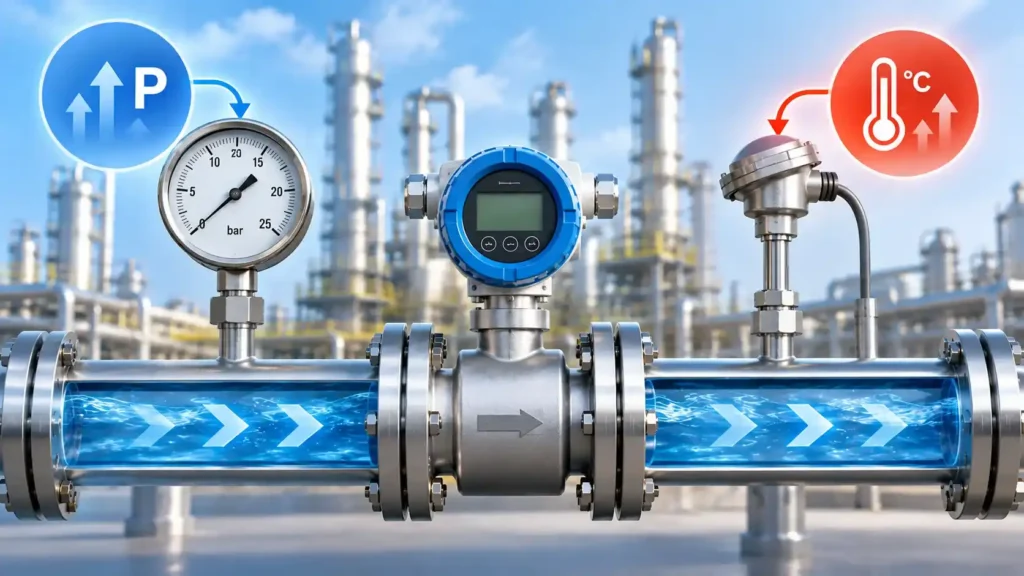
Pressure and temperature can significantly influence flow measurement, particularly when measuring gases, steam and fluids whose density changes with operating conditions.
Understanding these effects helps engineers select the right flow meter, apply appropriate compensation and maintain reliable measurements as process conditions change.
How Pressure and Temperature Affect Flow Measurement
Pressure and temperature affect flow measurement mainly by changing fluid properties such as density and viscosity. The effect is especially important for gases and steam because their density can change significantly with operating conditions.
Why Pressure and Temperature Matter in Flow Measurement
A flow meter may measure velocity, volumetric flow, mass flow or another parameter depending on its measurement principle. Pressure and temperature can influence the relationship between these quantities.
For example, a gas occupying a particular volume at one pressure and temperature will not have the same density when the pressure or temperature changes. If the process requires mass flow or standardized volume, these changes must be considered.
Key Point:
Pressure and temperature do not affect every flow meter in the same way. The measurement principle, fluid type and required output determine whether compensation is necessary.
How Temperature Affects Flow Measurement
Temperature changes the physical properties of most fluids. In particular, density and viscosity can change as temperature changes, which can influence the flow measurement.
For liquids, increasing temperature commonly reduces density and viscosity. For gases, increasing temperature generally reduces density at a given pressure. These changes can affect calculations that convert volumetric flow into mass flow.
Density
Temperature changes fluid density, affecting the relationship between volumetric and mass flow.
Viscosity
Temperature can change viscosity, which may influence flow behaviour and the response of some flow meter technologies.
Material Effects
High process temperatures can affect meter materials, liners, electronics and mechanical components.
How Pressure Affects Flow Measurement
Pressure is particularly important in gas and steam applications because pressure changes can produce significant changes in fluid density.
For liquids, pressure normally has a much smaller effect on density than it does for gases. However, pressure remains important when checking the meter's pressure rating, process conditions and the behaviour of compressible fluids.
Did You Know?
A gas flow meter can show a different volumetric flow value when pressure changes even when the amount of gas being transferred on a mass basis remains comparable.
Pressure, Temperature and Fluid Density
Density is the key link between pressure, temperature and many flow calculations. For gases, density changes strongly with both pressure and absolute temperature.
For an ideal gas, the relationship can be represented as:
Ideal Gas Relationship
ρ = P × M ÷ R × T
ρ = gas density | P = absolute pressure |
M = molar mass | R = gas constant | T = absolute temperature
This simplified relationship is useful for understanding the direction of the effect. Real gases may require a compressibility factor or more detailed property calculations, particularly at higher pressures.
Why Absolute Pressure and Temperature Are Important
Gas compensation calculations require pressure and temperature to be handled using the appropriate absolute references.
Temperature must be converted to an absolute temperature scale such as Kelvin. Pressure should also be expressed as absolute pressure when used in gas-law calculations.
Common Mistake:
Using gauge pressure directly in a gas-density calculation can produce an incorrect result. The conversion between gauge and absolute pressure must be considered before applying the calculation.
For more information about absolute, gauge and differential pressure, see our article on Types of Pressure Measurements .
Temperature and Pressure Compensation in Flow Measurement
Compensation is used when the measured flow needs to be corrected for changes in pressure and temperature. A flow meter or flow computer can use additional pressure and temperature inputs to calculate a corrected flow value.
Flow Signal
+
Pressure
+
Temperature
→
Compensated Flow
The compensation method depends on the fluid and measurement technology. Gas applications may use density or compressibility calculations, while steam applications generally require steam property data.
A detailed discussion of these methods is available in InstrumentationBlog's Temperature and Pressure Compensation in Flow Measurement .
How Temperature and Pressure Affect Gas Flow Measurement
Gas is compressible, making pressure and temperature particularly important in gas flow measurement. A volumetric reading taken at line conditions can change when the gas pressure or temperature changes.
If the application requires standard volume, the measured flow must be converted from operating conditions to the specified reference conditions.
Example: Effect of Temperature on Gas Density
Consider a gas flowing at constant pressure. If its absolute temperature increases, its density decreases.
This means that the same mass of gas occupies a larger volume at the higher temperature.
Higher temperature → Lower gas density → Larger volume for the same mass
How Temperature and Pressure Affect Steam Flow Measurement
Steam flow measurement requires careful consideration of pressure and temperature because steam properties vary with operating conditions.
Saturated steam has a defined relationship between pressure and saturation temperature, while superheated steam requires both pressure and temperature to determine its thermodynamic properties.
For applications requiring mass flow, energy measurement or standardized reporting, the flow measurement system may use pressure and temperature inputs together with appropriate steam property calculations.
Effect on Differential Pressure Flow Meters
Differential pressure flow meters determine flow from the pressure difference created across a primary element such as an orifice plate, Venturi or flow nozzle.
For compressible fluids, density is an important part of the flow calculation. Changes in pressure and temperature can therefore affect the calculated flow if they are not properly accounted for.
The general relationship can be represented as:
Simplified DP Flow Relationship
Q ∝ √(ΔP ÷ ρ)
Q = flow | ΔP = differential pressure | ρ = fluid density
The actual calculation is more detailed and depends on the primary element, fluid properties and applicable standards.
Effect on Vortex Flow Meters
Vortex flow meters measure the frequency of vortices generated by a bluff body. The measured vortex frequency is related to flow velocity, while density changes can become important when converting volumetric flow into mass flow.
Temperature and pressure compensation can therefore be important in gas and steam applications where density varies substantially.
Our Vortex Flow Meter Troubleshooting article also discusses incorrect pressure and temperature compensation as a possible cause of flow-reading errors.
Effect on Coriolis Flow Meters
Coriolis flow meters measure mass flow directly, so they do not require the same pressure and temperature compensation approach used by many volumetric gas flow meters.
However, process temperature and pressure still matter. They can affect density, zero stability, material limits and the overall measurement uncertainty of the instrument.
Therefore, direct mass measurement does not mean that process conditions can be ignored during meter selection and installation.
Effect on Electromagnetic Flow Meters
Electromagnetic flow meters are primarily used for conductive liquids and measure flow velocity using electromagnetic induction. Pressure and temperature generally do not require gas-style density compensation for the basic volumetric flow measurement.
However, temperature can influence fluid conductivity, while process temperature and pressure must remain within the meter's specified operating limits.
Our article on how electromagnetic flow meters work provides more information about this measurement technology.
Volumetric Flow vs Mass Flow Under Changing Conditions
The difference between volumetric and mass flow becomes particularly important when pressure and temperature vary.
| Parameter | Volumetric Flow | Mass Flow |
|---|---|---|
| Measures | Volume per unit time | Mass per unit time |
| Effect of density | Important when converting to mass or standard volume | Mass itself is independent of density |
| Gas pressure changes | Can significantly change actual volume | Direct mass measurement avoids this volume effect |
| Gas temperature changes | Can significantly change actual volume | Direct mass measurement avoids this volume effect |
| Typical correction | Density or pressure/temperature compensation may be required | Depends on meter technology and application |
For a broader explanation, read our article: Volumetric Flow vs Mass Flow .
Actual Flow, Standard Flow and Normal Flow
Gas flow can be reported at actual operating conditions or converted to a reference condition. This distinction is important when comparing measurements from different systems.
Actual flow represents the gas volume at the current process pressure and temperature. Standard or normal flow represents the equivalent volume at a specified reference condition.
KLEEV Tip:
Always check the reference temperature and pressure when comparing gas-flow values. Terms such as Nm³/h and Sm³/h can refer to different reference conditions depending on the applicable standard or project specification.
When Is Pressure and Temperature Compensation Required?
Gas Flow
Compensation is often important because gas density changes significantly with pressure and temperature.
Steam Flow
Pressure and temperature are important for determining steam properties and calculating mass or energy flow.
Liquid Flow
Compensation may be needed when temperature significantly changes density, viscosity or another property relevant to the measurement.
Common Mistakes in Pressure and Temperature Compensation
- Using gauge pressure instead of absolute pressure in gas calculations.
- Using Celsius directly where absolute temperature is required.
- Using an incorrect reference temperature or pressure.
- Ignoring changes in gas density.
- Using incorrect fluid-property data for steam.
- Installing pressure and temperature sensors too far from the flow measurement point.
- Entering incorrect pressure or temperature units into the flow computer.
- Assuming every flow meter requires the same compensation method.
- Ignoring the manufacturer's compensation requirements.
Important:
A compensation system is only as reliable as its input signals. Incorrect pressure, temperature, units or fluid-property data can introduce a systematic error into the final flow value.
How to Improve Flow Measurement Accuracy
Reliable flow measurement starts with selecting a meter that matches the fluid and operating conditions. Pressure and temperature should be considered during meter sizing, installation, configuration and commissioning.
- Define the minimum, normal and maximum pressure.
- Define the minimum, normal and maximum temperature.
- Identify whether the fluid is liquid, gas or steam.
- Determine whether volumetric, mass or standardized flow is required.
- Check the meter's process pressure and temperature limits.
- Use the correct fluid-property data.
- Verify pressure and temperature transmitter calibration.
- Check compensation settings during commissioning.
Flow meter accuracy is also influenced by installation, calibration and fluid properties. See our article on Flow Meter Accuracy and Repeatability for additional considerations.
Conclusion
Pressure and temperature affect flow measurement primarily by changing fluid density and other physical properties. The effect is especially significant for gases and steam, where changes in operating conditions can substantially change the relationship between volume and mass.
The correct approach depends on the flow meter technology and application. Some applications require pressure and temperature compensation, while others measure mass directly or are less sensitive to these changes.
Before selecting a flow meter, always consider the complete operating envelope, including fluid type, pressure, temperature, flow range, required output and measurement accuracy.
Need Help With Flow Measurement?
Share your fluid type, flow range, operating pressure and temperature with our team. We can help you select a suitable flow measurement technology and identify the key measurement and compensation requirements for your process.
We support flow measurement requirements for water, wastewater, oil and gas, chemical processing, utilities, steam, compressed air and other industrial applications.
KLEEV Middle East FZE · P.O. Box 17259 · Plot M00767 · JAFZA (North), Dubai, UAE
19 Views