
FLOW MEASUREMENT
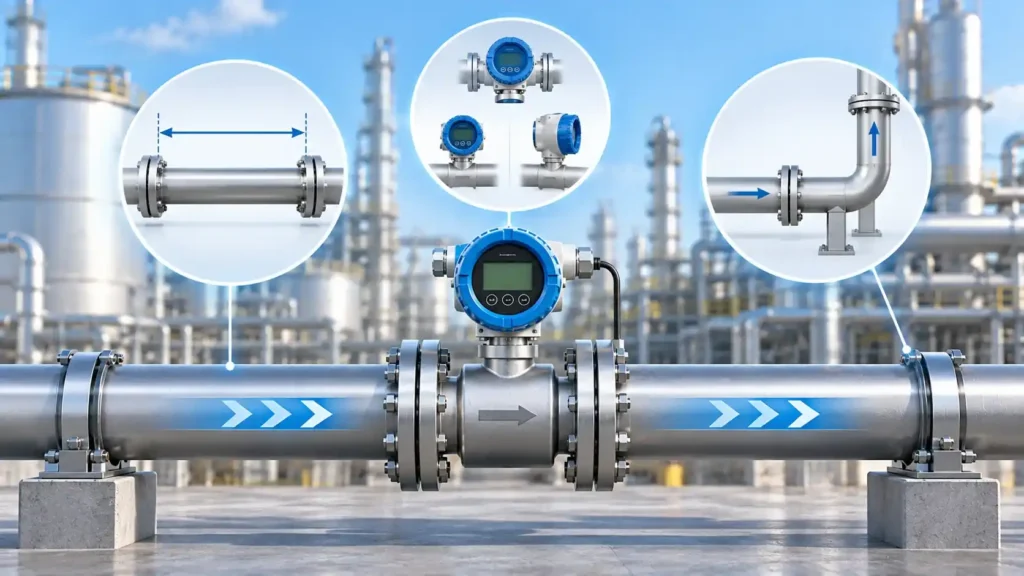
Proper flow meter installation is essential for obtaining stable and accurate measurements. Straight pipe length, meter orientation, flow direction and piping layout can all affect measurement performance.
Learn the key flow meter installation requirements, including upstream and downstream straight runs, correct orientation, full-pipe conditions and common piping mistakes to avoid.
Flow Meter Installation
Flow meter installation directly affects measurement accuracy, stability and long-term reliability. Correct straight runs, orientation and piping conditions help the meter operate within its specified performance.
Why Is Proper Flow Meter Installation Important?
A flow meter does not measure only the presence of moving fluid. Most flow measurement technologies respond to the velocity profile, flow direction, fluid condition and other characteristics of the process stream.
Elbows, tees, valves, reducers, pumps and other piping components can disturb the flow profile. If the meter is installed too close to these disturbances, the velocity distribution at the measuring point may not match the conditions assumed during calibration.
Key Point:
The manufacturer's installation instructions should always take priority over generic straight-run rules. Required distances can vary significantly between flow meter technologies and individual models.
Flow Meter Straight Run Requirements
Straight pipe run refers to the unobstructed length of pipe installed before and after the flow meter. The upstream section is particularly important because it allows disturbances in the velocity profile to reduce before the fluid reaches the measuring element.
A commonly used general guideline is 10D upstream and 5D downstream, where D represents the relevant pipe diameter. However, this is not a universal requirement. Some meters require shorter runs, while others may require much longer distances depending on the upstream disturbance and measurement principle.
Upstream Piping
→
Straight Run
→
Flow Meter
→
Downstream Run
For example, a meter installed immediately downstream of an elbow may experience a different velocity profile from one installed after a sufficiently long straight section.
What Affects the Required Straight Pipe Length?
The required straight-run distance depends on the type and location of piping disturbances around the meter. Common sources of flow disturbance include:
- 90-degree elbows
- Multiple elbows close together
- Tees and branch connections
- Partially open control valves
- Reducers and expanders
- Pumps and compressors
- Pipe entrances and exits
- Other devices that create swirl or turbulence
A single elbow may require a different upstream distance from two elbows installed in different planes. A control valve that is partially closed can create a stronger disturbance than a fully open valve.
| Upstream Condition | Potential Effect | Installation Consideration |
|---|---|---|
| Single elbow | Changes velocity distribution and may create swirl. | Provide the manufacturer's recommended upstream straight run. |
| Two elbows | Can create stronger and more complex flow disturbances. | Additional straight length may be required. |
| Control valve | May generate significant turbulence when throttling. | Avoid placing a meter immediately downstream. |
| Reducer or expander | Changes velocity and pressure distribution. | Follow the meter-specific piping requirements. |
| Pump discharge | Can introduce turbulence and swirl. | Allow sufficient distance for the flow profile to stabilize. |
What Do 10D and 5D Mean in Flow Meter Installation?
The terms 10D and 5D express straight pipe length as multiples of pipe diameter. If the applicable pipe diameter is 100 mm, for example, 10D corresponds to 1,000 mm and 5D corresponds to 500 mm.
Straight Run Calculation
Straight Length = D × Required Diameter Multiples
D = applicable pipe diameter
Worked Example: 10D / 5D Installation
Assume a pipe diameter of 100 mm and a general installation guideline of 10D upstream and 5D downstream.
Upstream = 100 × 10 = 1,000 mm
Downstream = 100 × 5 = 500 mm
Required straight length = 1,000 mm upstream + 500 mm downstream
Important:
Do not automatically apply 10D/5D to every flow meter. Always check the manufacturer's datasheet because the actual requirement may be different.
Flow Meter Orientation and Mounting Position
Correct orientation is another important part of flow meter installation. The preferred mounting position depends on the measurement technology, fluid properties and piping arrangement.
In liquid applications, the meter should generally be installed where the pipe remains completely filled during normal operation. A partially filled pipe can produce unstable or incorrect measurement conditions for many flow meters.
Horizontal Installation
A horizontal installation can be suitable when the pipe remains fully flooded and the meter's sensing elements are correctly positioned.
Vertical Installation
Vertical piping with upward flow can help maintain a full liquid-filled measuring section in many applications.
Downward Flow
Downward liquid flow can increase the risk of a partially filled pipe and should be avoided where the meter requires a full pipe.
Why Must the Flow Meter Pipe Remain Full?
Many liquid flow meters are designed to measure a completely filled pipe. If air enters the measuring section or the liquid level falls below the pipe cross-section, the meter may no longer operate under its intended conditions.
Good installation practice therefore avoids locations where the pipe can drain, trap air or operate intermittently full.
KLEEV Tip:
For liquid service, avoid placing the meter at the highest point of a piping system when that location could allow air accumulation or cause the pipe to become partially filled.
Check the Flow Direction Before Installation
Many inline flow meters have an arrow or other marking that indicates the intended process flow direction. The meter should be installed so that the process flow follows the manufacturer's specified direction.
Incorrect flow direction can cause measurement errors, incorrect signal interpretation or improper operation depending on the meter technology.
Before tightening the meter into the pipeline, verify the arrow on the meter body against the actual piping flow direction shown on the P&ID or process documentation.
Pipe Size and Flow Meter Installation
The flow meter should be installed with piping that is compatible with the meter's specified line size and installation arrangement. Sudden changes in pipe diameter around the measuring element can disturb the velocity profile.
When reducers or expanders are required, their configuration and location should follow the manufacturer's installation instructions.
Pipe alignment is also important. The meter should not be forced into position to compensate for misaligned piping because this can introduce mechanical stress on the meter body, flanges or connections.
Where Should Valves and Fittings Be Installed?
Valves and fittings should be positioned so that they do not create unacceptable flow disturbances immediately upstream of the meter.
Where possible, provide adequate straight pipe between the meter and nearby elbows, tees, reducers and control valves. A control valve located downstream can sometimes be preferable because the meter sees a less disturbed upstream flow profile.
Did You Know?
The same nominal straight-run distance does not necessarily provide the same flow conditions for every piping arrangement. The type and position of the upstream disturbance can affect the required installation distance.
Flow Meter Installation Requirements by Technology
Different flow meter technologies respond differently to upstream disturbances, which is why installation requirements should be considered during meter selection rather than only after the piping has been designed.
| Flow Meter Type | Installation Consideration | Important Point |
|---|---|---|
| Electromagnetic | Requires suitable pipe conditions and correct sensor orientation. | Maintain a full pipe and follow the manufacturer's straight-run requirements. |
| Vortex | Flow disturbances can affect vortex formation. | Proper upstream and downstream piping is important. |
| Turbine | Rotor response is sensitive to the incoming velocity profile. | Sufficient straight run is particularly important. |
| Ultrasonic | Installation geometry and flow profile can influence measurement. | Follow the manufacturer's sensor spacing and piping requirements. |
| Differential Pressure | Primary element installation has defined upstream and downstream requirements. | Follow applicable standards and the element manufacturer's instructions. |
| Coriolis | Generally less dependent on long straight runs than many velocity-based meters. | Mechanical support, orientation and process conditions remain important. |
For a broader overview of flow measurement technologies, see Types of Flow Meters on InstrumentationBlog.
Common Flow Meter Installation Mistakes
Many flow measurement problems are caused by installation conditions rather than a defective instrument. The following mistakes are particularly common:
- Installing the meter immediately after an elbow.
- Ignoring the manufacturer's straight-run requirement.
- Installing a liquid meter where the pipe can become partially filled.
- Installing the meter against the specified flow direction.
- Placing a control valve too close upstream.
- Using unsuitable reducers or abrupt diameter changes.
- Allowing air pockets to form around the measuring section.
- Ignoring mechanical pipe misalignment.
- Failing to consider maintenance and access requirements.
Installation Principle:
A flow meter should be installed where the process conditions are predictable, the pipe is suitable for the measurement technology and the meter can be maintained without compromising the piping arrangement.
Flow Meter Installation and Commissioning Checks
Installation should be followed by a structured commissioning check before the flow meter is placed into normal service.
Piping Check
→
Orientation
→
Flow Direction
→
Commissioning
- Confirm the meter is installed in the correct flow direction.
- Verify upstream and downstream straight runs.
- Check that the pipe remains full during operation where required.
- Confirm there are no unexpected leaks or mechanical stresses.
- Verify electrical connections and grounding where applicable.
- Check configured measurement units and process parameters.
- Compare the indicated flow with expected process conditions.
Installation quality should also be considered alongside calibration and meter performance. Our article on flow meter accuracy and repeatability explains why installation and operating conditions can influence measurement performance.
What If There Is Not Enough Straight Pipe?
Existing plants often have limited space for the recommended straight pipe run. Moving the meter may not always be practical, especially in retrofit projects.
In such cases, the first step is to check the specific manufacturer's installation requirements. Depending on the technology and application, a flow conditioner may be considered to improve the velocity profile.
However, a flow conditioner should not be treated as a universal substitute for the manufacturer's recommended piping arrangement. Its suitability depends on the flow meter, process fluid and installation geometry.
How Installation Requirements Affect Flow Meter Selection
Installation space should be considered before selecting a flow meter. A meter with demanding straight-run requirements may be difficult to install correctly in a compact skid or congested plant area.
If adequate straight pipe is unavailable, another measurement technology may provide a more practical solution, depending on the application.
Our Flow Meter Selection Guide provides additional guidance on selecting a suitable technology based on process and application requirements.
Flow Meter Installation in Water and Wastewater Systems
Water and wastewater applications frequently involve elbows, pumps, valves, reducers and other piping components that can influence the flow profile. Installation planning is therefore particularly important.
Full-pipe conditions, air management, pipe configuration and accessibility for maintenance should all be considered when locating the meter.
For application-specific considerations, see our article on flow measurement in water and wastewater treatment plants .
Flow Meter Installation Checklist
| Check | Requirement |
|---|---|
| Flow direction | Confirm the process flow matches the meter's specified direction. |
| Upstream straight run | Verify the required distance from elbows, tees, valves and other disturbances. |
| Downstream straight run | Confirm the required downstream distance according to the meter manual. |
| Pipe condition | Ensure the measuring section is suitable and properly aligned. |
| Full pipe | For liquid applications, ensure the meter remains completely flooded where required. |
| Orientation | Install the meter according to the manufacturer's recommended position. |
| Valves and fittings | Keep significant flow disturbances away from the meter where possible. |
| Maintenance access | Provide sufficient space for inspection, calibration and servicing. |
Conclusion
Correct flow meter installation is essential for reliable measurement. Straight pipe runs help reduce the effects of upstream flow disturbances, while correct orientation and piping layout help maintain the process conditions required by the meter.
There is no single straight-run rule that applies to every flow meter. The measurement technology, upstream piping configuration, fluid condition and manufacturer's specifications should always be considered together.
By planning the meter location before installation and checking the piping, orientation, flow direction and full-pipe conditions during commissioning, many common flow measurement problems can be avoided.
External Resources
Need Help With Flow Meter Installation?
Share your flow meter type, pipe size, fluid, operating conditions and existing piping arrangement. Our team can help review the application and identify suitable flow measurement solutions and installation considerations.
We support flow measurement requirements for water, wastewater, oil and gas, chemical processing, utilities, steam, compressed air and other industrial applications.
KLEEV Middle East FZE · P.O. Box 17259 · Plot M00767 · JAFZA (North), Dubai, UAE
17 Views