
FLOW MEASUREMENT
Volumetric flow and mass flow are two fundamental ways of measuring fluid movement in industrial process systems.
Although they are closely related, they represent different quantities. Understanding the difference is important when selecting flow meters, calculating process quantities and configuring flow measurement systems.
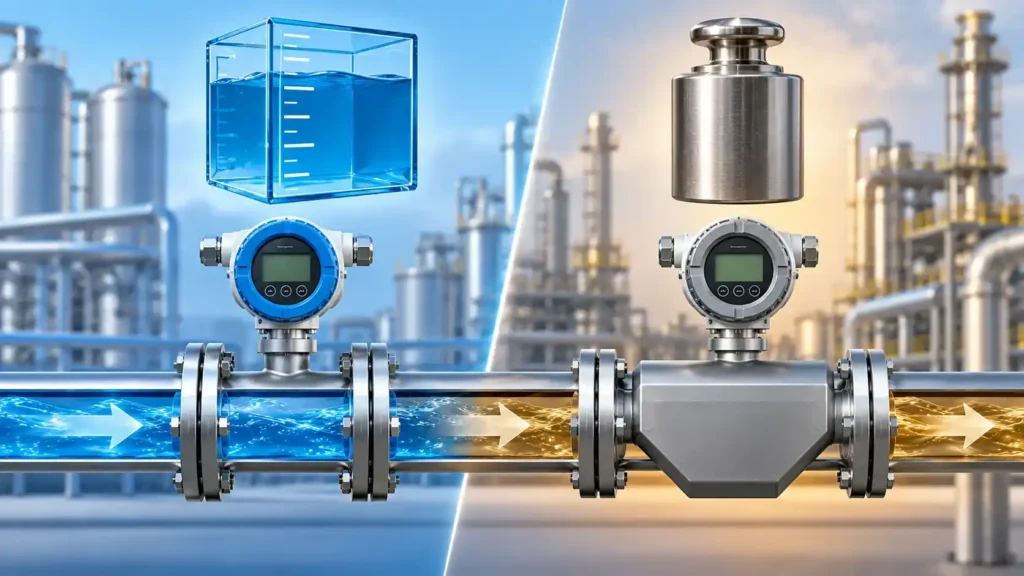
Volumetric flow measures fluid volume per unit time, while mass flow measures the actual mass transferred. Understanding the difference helps in accurate flow measurement, meter selection, and process control.
Volumetric Flow vs Mass Flow
The main difference between volumetric flow and mass flow is what is being measured. Volumetric flow describes the volume of fluid passing through a point per unit of time, while mass flow describes the mass of fluid passing through a point per unit of time.
Key Difference:
Volumetric flow tells you how much space the fluid occupies per unit time.
Mass flow tells you how much actual matter is moving per unit time.
The two measurements are connected through fluid density. Therefore, understanding density is essential when converting between volumetric flow and mass flow.
What Is Volumetric Flow?
Volumetric flow rate is the volume of fluid passing through a particular point or cross-sectional area per unit of time.
It is commonly represented by Q. Typical units include m³/h, m³/s, L/min, L/s and ft³/min.
Volumetric Flow Formula
Q = V ÷ t
Q = volumetric flow rate | V = volume | t = time
Volumetric flow can also be calculated from the cross-sectional area of a pipe and the average velocity of the fluid.
Velocity Relationship
Q = A × v
A = pipe cross-sectional area | v = average fluid velocity
Volumetric Flow Example
Suppose 60 m³ of water passes through a pipeline in 3 hours.
Worked Example
V = 60 m³
t = 3 h
Q = 60 ÷ 3
Volumetric Flow = 20 m³/h
What Is Mass Flow?
Mass flow rate is the mass of fluid passing through a point per unit of time.
It is commonly represented by ṁ. Typical units include kg/h, kg/s, g/s and lb/h.
Mass Flow Formula
ṁ = m ÷ t
ṁ = mass flow rate | m = mass | t = time
Mass Flow Example
Suppose 5,000 kg of a liquid passes through a process line in 4 hours.
Worked Example
m = 5,000 kg
t = 4 h
ṁ = 5,000 ÷ 4
Mass Flow = 1,250 kg/h
Relationship Between Volumetric Flow and Mass Flow
Volumetric flow and mass flow are related by the density of the fluid.
Flow Relationship
ṁ = ρ × Q
ṁ = mass flow rate | ρ = fluid density | Q = volumetric flow rate
The relationship can also be rearranged to calculate volumetric flow from mass flow.
Rearranged Formula
Q = ṁ ÷ ρ
Q = volumetric flow rate | ṁ = mass flow rate | ρ = density
Did You Know?
The same volumetric flow rate can correspond to different mass flow rates when the fluids have different densities.
Volumetric Flow vs Mass Flow: Key Differences
| Parameter | Volumetric Flow | Mass Flow |
|---|---|---|
| Measures | Volume passing per unit time | Mass passing per unit time |
| Common Symbol | Q | ṁ |
| Typical Units | m³/h, L/min, ft³/min | kg/h, kg/s, lb/h |
| Density | Not required for the basic measurement | Important when relating mass flow to volume |
| Pressure & Temperature Effects | Especially important for gases | Mass itself is not changed by pressure or temperature |
| Common Applications | Water, liquid transfer and utility systems | Batching, dosing, material balance and mass-based control |
Why Density Matters
Density is the property that connects mass and volume. It represents the amount of mass contained in a given volume.
Density Formula
ρ = m ÷ V
ρ = density | m = mass | V = volume
From this relationship:
Mass From Volume
m = ρ × V
Therefore, if fluid density is known, a volumetric flow measurement can be converted into an equivalent mass flow measurement.
Volumetric Flow vs Mass Flow for Liquids
For many liquid applications, volumetric flow is a practical measurement because liquid density may remain relatively stable under normal operating conditions.
Water distribution, cooling water, wastewater, chemical transfer and general pumping systems are examples where volumetric flow is commonly useful.
However, liquid density can change with temperature, pressure and composition. These changes should be considered when high-accuracy mass calculations are required.
KLEEV Tip:
If the process quantity is specified in kilograms or tonnes, do not assume that a volumetric measurement alone represents the required process quantity. Check the fluid density and its operating conditions.
Volumetric Flow vs Mass Flow for Gases
The distinction becomes particularly important for gases because gas density can change significantly with pressure and temperature.
A gas occupying a specific volume at one pressure and temperature can occupy a different volume at another pressure and temperature, even though the amount of gas has not changed.
This is why gas flow specifications often identify the reference or standard conditions associated with the volumetric flow value.
Important:
When comparing gas flow rates, always check the pressure and temperature conditions associated with the stated volumetric flow. Actual and standard volumetric flow values should not be treated as identical.
Actual Flow vs Standard Flow
Gas flow can be reported at actual operating conditions or converted to a defined reference condition. These two values describe the same gas quantity on different volume bases.
| Flow Basis | Description | Typical Use |
|---|---|---|
| Actual Volumetric Flow | Volume occupied by the gas at its actual operating pressure and temperature. | Process piping and equipment operating conditions. |
| Standard Volumetric Flow | Gas volume referenced to specified standard or reference conditions. | Gas reporting, comparison and process calculations. |
| Mass Flow | Actual mass passing through the measurement point per unit time. | Material balance, dosing and mass-based process control. |
For a deeper explanation of gas measurement conditions, see density correction in flow measurement .
Which Flow Measurement Is Better?
Neither volumetric flow nor mass flow is universally better. The appropriate measurement depends on what the process needs to control, calculate or report.
Volumetric Flow
Useful when the process requirement is based primarily on the volume of fluid being transported.
Mass Flow
Useful when the actual quantity of material is more important than the volume it occupies.
Density
Provides the relationship required to convert between mass flow and volumetric flow.
When Should You Use Volumetric Flow?
Volumetric flow is commonly selected when the process is concerned with the amount of fluid volume being transported through a pipeline.
- Water supply and distribution
- Cooling water systems
- Wastewater systems
- Liquid transfer
- Hydraulic applications
- Utility flow measurement
KLEEV's flow measurement guide for water and wastewater treatment plants also explains how different flow meter technologies are applied to liquid measurement.
When Should You Use Mass Flow?
Mass flow is particularly useful when the process requires the actual quantity of material to be measured regardless of changes in density or volume.
- Batching and recipe control
- Chemical dosing
- Material balance calculations
- Mass-based process control
- Gas measurement
- Accurate product quantity measurement
For a more detailed discussion of mass flow measurement technology, see mass flow meters and Coriolis flow measurement .
Flow Meter Technologies for Volumetric and Mass Flow
Electromagnetic Flow Meters
Electromagnetic flow meters measure the velocity of conductive liquids and use the pipe area to determine volumetric flow. They are widely used in water, wastewater and conductive liquid applications.
Read more about the working principle and industrial applications of electromagnetic flow meters .
Vortex Flow Meters
Vortex flow meters detect the frequency of vortices generated by a bluff body. They can be used for liquid, gas and steam measurement depending on the meter design and process conditions.
Ultrasonic Flow Meters
Ultrasonic flow meters use ultrasonic signals to determine fluid velocity and calculate flow. They are available for different liquid and gas applications.
Coriolis Mass Flow Meters
Coriolis flow meters are widely used when direct mass flow measurement is required. They can also provide density-related measurement information.
The Coriolis flow meter troubleshooting guide explains why process conditions can influence Coriolis measurement performance.
Variable Area Flow Meters
Variable area flow meters provide local indication of flow based on the position of a float inside a tapered measuring tube. They are commonly used for simple flow indication applications.
Volumetric Flow to Mass Flow Calculation
Consider a liquid with a volumetric flow rate of 25 m³/h and a density of 800 kg/m³.
Worked Example
Q = 25 m³/h
ρ = 800 kg/m³
Using:
ṁ = ρ × Q
ṁ = 800 × 25
Mass Flow = 20,000 kg/h
Mass Flow to Volumetric Flow Calculation
The same relationship can be rearranged when the mass flow rate and density are known.
Worked Example
Mass Flow = 12,000 kg/h
Density = 600 kg/m³
Q = ṁ ÷ ρ
Q = 12,000 ÷ 600
Volumetric Flow = 20 m³/h
Common Mistakes When Comparing Mass and Volumetric Flow
Ignoring Density
Mass and volume cannot be directly compared without considering the density of the fluid.
Mixing Units
Ensure mass, volume and time units are consistent before performing calculations.
Ignoring Gas Conditions
Gas volumetric flow depends strongly on pressure and temperature conditions.
Using the Wrong Density
Using a density value that does not represent the actual process temperature, pressure or fluid composition can introduce errors into a mass-flow calculation.
Confusing Actual and Standard Gas Flow
Gas flow values should always be checked for their measurement or reference conditions before comparing them.
Choosing a Meter Without Defining the Required Variable
The required process variable should be established first. A process requiring mass-based measurement may need a different measurement approach from one requiring volumetric flow.
Why the Difference Matters in Process Control
The choice between volumetric and mass flow can affect process control, batching, inventory calculations, equipment sizing and material balance.
For example, a process may require 1,000 kg of a chemical rather than a fixed volume. If the chemical density changes with temperature, delivering a fixed volume may not always deliver the same mass.
Conversely, a cooling-water system may simply require a specified volume of water per hour because the process is designed around volumetric circulation.
Measurement quality also matters when choosing between flow technologies. KLEEV's article on flow meter accuracy and repeatability explains the factors that influence reliable flow measurement.
Volumetric Flow vs Mass Flow: Quick Comparison
Volume
→
Volumetric Flow
→
Q
Density
×
Volumetric Flow
→
Mass Flow
Frequently Asked Questions
What is the difference between volumetric flow and mass flow?
Volumetric flow measures the volume of fluid passing through a point per unit time, while mass flow measures the mass of fluid passing through a point per unit time.
What is the formula for converting volumetric flow to mass flow?
The basic relationship is ṁ = ρ × Q, where ṁ is mass flow, ρ is fluid density and Q is volumetric flow.
What is the formula for converting mass flow to volumetric flow?
Volumetric flow can be calculated using Q = ṁ ÷ ρ when the mass flow rate and fluid density are known.
Is mass flow better than volumetric flow?
Neither is universally better. The correct measurement depends on the process requirement and whether the application is based on material mass or fluid volume.
Why is mass flow important for gases?
Gas density changes with pressure and temperature, which means gas volume can change significantly even when the actual quantity of gas remains the same. Mass flow directly represents the amount of material.
Can a volumetric flow meter measure mass flow?
A volumetric flow meter measures volume directly. Mass flow can be calculated when the fluid density is known or measured and the appropriate compensation is applied.
Which flow meter directly measures mass flow?
Coriolis mass flow meters are commonly used for direct mass flow measurement.
What units are used for volumetric flow?
Common volumetric flow units include m³/h, m³/s, L/min, L/s and ft³/min.
What units are used for mass flow?
Common mass flow units include kg/h, kg/s, g/s and lb/h.
Conclusion
The difference between volumetric flow and mass flow is fundamentally the difference between measuring fluid volume per unit time and fluid mass per unit time.
Volumetric flow is useful when the process is concerned with the amount of fluid volume being transported, while mass flow is preferred when the actual quantity of material is important.
Density provides the connection between the two measurements. Using ṁ = ρ × Q, volumetric flow can be converted into mass flow, while Q = ṁ ÷ ρ allows mass flow to be converted back into volumetric flow.
Understanding this difference helps engineers select the right flow measurement technology, configure measurement systems correctly and avoid errors when comparing process flow values.
Need Help With Flow Measurement?
Our team can help you select the right flow measurement solution based on your fluid, flow range, pipe size, process conditions and measurement requirements.
KLEEV Middle East FZE · P.O. Box 17259 · Plot M00767 · JAFZA (North), Dubai, UAE
28 Views