
What Is Differential Pressure and How Is It Measured?
Pressure measurement in industrial systems often requires more than knowing the pressure at a single point. Engineers frequently need to determine the difference in pressure between two locations to evaluate flow, monitor equipment performance, detect restrictions and measure process conditions. This difference is known as differential pressure.
Differential pressure measurement is widely used across process plants, refineries, water treatment systems, HVAC installations and utility applications. It can be measured using differential pressure gauges, differential pressure transmitters and other suitable instruments. A proper understanding of the high-pressure and low-pressure sides, measurement range, installation and application requirements is essential for obtaining a reliable differential pressure measurement.
Differential Pressure
Differential Pressure is the difference between the pressure measured at two different points in a system. Instead of measuring pressure relative to atmospheric pressure or a vacuum, differential pressure compares two process pressures directly.
It is commonly represented as the pressure at the high-pressure side minus the pressure at the low-pressure side. Differential pressure is particularly useful when the pressure difference itself provides information about flow, level, filter condition or equipment performance.
Differential pressure is a comparison between two pressure points. The measurement does not simply indicate the absolute pressure of either point; it indicates how much the two pressures differ.
What Is Differential Pressure?
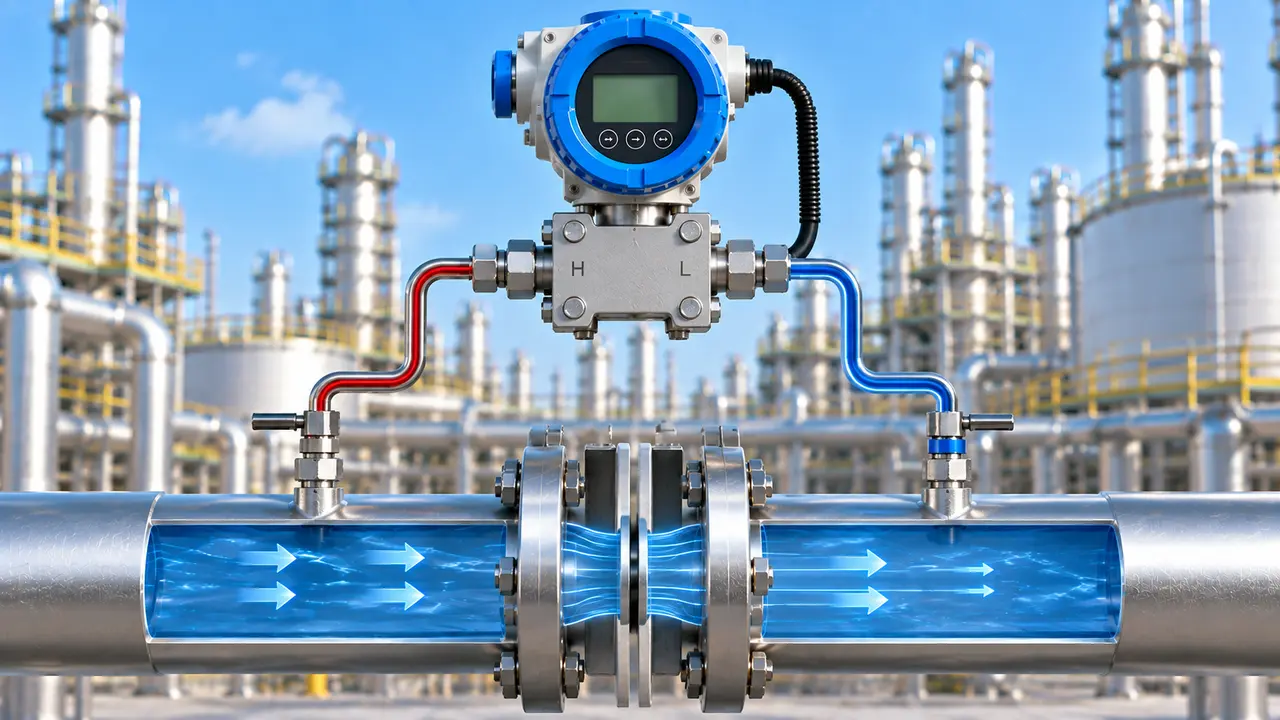
Consider a pipe carrying fluid through a restriction. The pressure upstream of the restriction is higher than the pressure downstream. The difference between these two pressures is the differential pressure across the restriction.
The two pressure connections are commonly referred to as the high-pressure (HP) and low-pressure (LP) sides. The instrument determines the pressure difference between these two sides.
How Is Differential Pressure Calculated?
Differential pressure is calculated by subtracting the lower pressure from the higher pressure. The same pressure units must be used for both measurements.
Suppose the pressure at the upstream side of a filter is 5.8 bar and the pressure at the downstream side is 5.1 bar.
The differential pressure across the filter is:
ΔP = PHigh − PLow
ΔP = 5.8 − 5.1
Differential Pressure = 0.7 bar
How Is Differential Pressure Measured?
Differential pressure can be measured by connecting an instrument to two pressure points. One connection senses the high-pressure side and the other senses the low-pressure side. The instrument then measures the difference between these two pressures.
Depending on the application, the output may be a local mechanical indication, a 4–20 mA electrical signal or a digital communication signal. The selected instrument should match the required pressure range, accuracy and process conditions.
What Is a Differential Pressure Transmitter?
A differential pressure transmitter is an instrument designed to measure the pressure difference between two process connections and convert that measurement into a usable output signal.
The transmitter contains a sensing element that responds to the pressure difference. Internal electronics process the sensor signal and produce an output that can be transmitted to a PLC, DCS, SCADA system or other monitoring equipment.
A common industrial output is 4–20 mA. Modern transmitters may also support digital communication and provide additional diagnostic information depending on their design.
How Does a Differential Pressure Transmitter Work?
The transmitter continuously compares the pressure applied to its high- and low-pressure sides. The resulting differential pressure is converted into an electrical signal corresponding to the configured measurement range.
For example, a transmitter configured for 0 to 10 bar differential pressure may represent 0 bar differential pressure with approximately 4 mA and 10 bar with approximately 20 mA, subject to the transmitter configuration.
Differential Pressure vs Gauge Pressure
Differential pressure and gauge pressure are not the same measurement. Gauge pressure compares process pressure with atmospheric pressure, while differential pressure compares two process pressures.
| Pressure Type | What It Compares | Typical Application |
|---|---|---|
| Differential Pressure | Pressure at two process points | Flow, filter monitoring and level measurement |
| Gauge Pressure | Process pressure relative to atmospheric pressure | Pipe, vessel and equipment pressure monitoring |
| Absolute Pressure | Process pressure relative to a vacuum reference | Vacuum, gas and specialized process applications |
Applications of Differential Pressure Measurement
Differential pressure measurement is used in many industrial applications because a pressure difference can provide useful information about the process without directly measuring the desired variable.
Flow Measurement
Differential pressure across a primary element can be used to determine fluid flow in suitable applications.
Filter Monitoring
Increasing differential pressure can indicate increasing resistance caused by filter loading or fouling.
Level Measurement
Differential pressure can be used to infer liquid level in suitable tanks and vessels.
Differential Pressure for Flow Measurement
One of the most important applications of differential pressure is flow measurement. A restriction such as an orifice plate creates a pressure difference between the upstream and downstream sides.
The measured differential pressure can then be related to flow rate using the appropriate flow equation and application-specific parameters.
This principle is widely used with differential-pressure flow measurement systems. For additional information, see this guide to orifice plate flow measurement .
Differential Pressure for Filter Monitoring
Filters create resistance to fluid flow. As a filter becomes loaded with particles or contaminants, the pressure difference between the upstream and downstream sides can increase.
Monitoring differential pressure therefore provides a convenient way to determine when a filter may require inspection, cleaning or replacement, depending on the process and manufacturer's specified limits.
A rising differential pressure across a filter does not by itself identify the exact cause of the restriction. Check the filter condition, flow rate, valves and other process conditions before taking corrective action.
Differential Pressure for Level Measurement
Differential pressure can be used to measure liquid level in tanks and vessels because the pressure produced by a liquid column is related to the liquid's height and density.
In a typical closed vessel, a differential pressure transmitter can sense the pressure at the bottom of the vessel and compare it with the pressure at the top. The difference can then be used to infer the liquid level when the application and transmitter configuration are suitable.
The relationship between pressure, liquid density and height means that changes in fluid density can affect the inferred level. Process conditions should therefore be considered during instrument selection and configuration.
Differential Pressure Across Pumps and Equipment
Differential pressure can also be used to evaluate pressure gain or pressure loss across equipment. Measuring pressure at the inlet and outlet of a pump, heat exchanger, valve or other component can provide useful information about system operation.
For example, comparing pump suction and discharge pressure can help operators understand whether the pump is producing the expected pressure increase under the current operating conditions.
Types of Differential Pressure Instruments
| Instrument | Indication / Output | Typical Use |
|---|---|---|
| Differential Pressure Gauge | Local mechanical or visual indication | Local monitoring of pressure difference |
| Differential Pressure Transmitter | 4–20 mA and/or digital communication | Remote monitoring and process control |
| Electronic DP Sensor | Electrical or digital signal | Specialized measurement and electronic systems |
What Is High Side and Low Side in Differential Pressure?
A differential pressure instrument has two process connections. The connection exposed to the higher pressure is normally called the high-pressure or HP side, while the connection exposed to the lower pressure is called the low-pressure or LP side.
The transmitter measures the difference between these two inputs. Correct identification and connection of the HP and LP sides are therefore essential for obtaining the intended measurement.
Always follow the manufacturer's installation instructions when connecting the high- and low-pressure sides. Incorrect connections can produce an incorrect measurement and, depending on the application, may damage the instrument.
Differential Pressure Measurement in Closed Vessels
Closed vessels can create additional pressure conditions because pressure may exist above the liquid surface. A differential pressure transmitter can compare the bottom pressure with the vessel's upper pressure to compensate for the pressure acting on the liquid surface.
This makes differential pressure measurement useful for level applications where the vessel is pressurized. The transmitter configuration must account for the vessel arrangement and installation conditions.
Factors Affecting Differential Pressure Measurement
Reliable differential pressure measurement depends on more than the transmitter itself. Process conditions, installation and impulse connections can all affect the measurement.
- Pressure range and differential pressure range.
- Static pressure in the process.
- Process temperature.
- Fluid density and viscosity.
- Impulse line installation.
- Blocked or restricted impulse lines.
- Leaks in pressure connections.
- Incorrect high- and low-pressure connections.
- Elevation differences between pressure connections.
- Instrument calibration and configuration.
Common Differential Pressure Measurement Problems
Incorrect HP and LP Connections
Reversing the high- and low-pressure connections can cause the transmitter to indicate an incorrect differential pressure or a reversed measurement.
Blocked Impulse Lines
Deposits, contamination or process material can restrict impulse lines and prevent the transmitter from accurately sensing process pressure.
Leaking Connections
Leakage in impulse piping or fittings can affect the pressure reaching the transmitter and produce measurement errors.
Unequal Installation Conditions
Differences in elevation, temperature or fluid conditions in impulse lines can influence the measurement, particularly in liquid and high-temperature applications.
How to Improve Differential Pressure Measurement Accuracy
Correct instrument selection and installation are essential for dependable differential pressure measurement. The transmitter range should be appropriate for the expected differential pressure, while the instrument must also be suitable for the maximum static pressure and process conditions.
- Select the correct differential pressure range.
- Verify maximum static pressure requirements.
- Correctly identify the HP and LP connections.
- Install impulse lines according to application requirements.
- Minimize leakage and unnecessary restrictions.
- Consider process temperature and fluid properties.
- Protect the measurement system from excessive vibration where necessary.
- Calibrate and verify the instrument according to the required maintenance program.
Our guide on types of pressure measurements provides additional information about the different pressure measurement methods used in industrial instrumentation.
Differential Pressure vs Pressure Drop
The terms differential pressure and pressure drop are often used together, but their context can differ. Differential pressure simply describes the difference between two pressure measurements. Pressure drop generally refers to a decrease in pressure as fluid passes through a component or section of a system.
For example, the pressure difference across a filter may be called differential pressure, while the same difference is commonly described as the pressure drop across the filter.
Differential pressure does not always represent a pressure loss. Depending on where the two measurement points are located, it can also represent a pressure increase, such as across a pump.
Example of Differential Pressure Measurement
A process filter has an upstream pressure of 4.5 bar and a downstream pressure of 4.0 bar.
Therefore:
ΔP = 4.5 bar − 4.0 bar = 0.5 bar
If the differential pressure gradually increases to 1.2 bar while the operating flow remains comparable, the change may indicate increasing resistance across the filter.
Initial differential pressure = 0.5 bar
Differential Pressure Measurement Selection Checklist
| Selection Factor | What to Consider |
|---|---|
| DP range | Determine the expected minimum, normal and maximum differential pressure. |
| Static pressure | Verify that the instrument can withstand the maximum process pressure. |
| Process fluid | Check wetted material compatibility and fluid characteristics. |
| Temperature | Consider process and ambient temperature limits. |
| Installation | Evaluate impulse lines, elevation and pressure connection arrangement. |
| Output | Select local indication, 4–20 mA or suitable digital communication. |
| Accuracy | Select an instrument suitable for the required measurement accuracy. |
| Application | Define whether the measurement is for flow, level, filter monitoring or equipment performance. |
Conclusion
Differential Pressure is the difference between the pressure at two points in a process system. It is one of the most useful measurement principles in industrial instrumentation because the pressure difference can provide information about flow, liquid level, filter condition and equipment performance.
Differential pressure can be measured using mechanical differential pressure gauges or electronic differential pressure transmitters. In automated systems, transmitters can provide a 4–20 mA or digital signal to PLC, DCS and SCADA systems for remote monitoring, alarming and control.
Reliable measurement depends on selecting the correct differential pressure range, considering static pressure and process conditions, correctly connecting the high- and low-pressure sides, and installing the pressure connections and impulse lines properly.
Need Help With Pressure Measurement?
Share your pressure range, process fluid, operating temperature and application requirements. Our team can help you identify a suitable differential pressure measurement solution for your application.
KLEEV Middle East FZE · P.O. Box 17259 · Plot M00767 · JAFZA (North), Dubai, UAE