

Table of Contents
Thermocouple Ranges and Applications
Temperature measurement is one of the most critical parameters in any industrial process. Whether it is a refinery heater, a boiler system, a food processing line, or a glass furnace, accurate temperature monitoring directly affects safety, product quality, and efficiency.
Among all temperature sensors, thermocouples remain one of the most widely used devices in industry due to their durability and wide temperature capability.
However, selecting the right sensor requires understanding thermocouple ranges and applications — not just temperature limits, but also process conditions and long-term performance.
This article explains the different thermocouple types, their temperature ranges, and where they are commonly used in real industrial environments.
What Is a Thermocouple?
A thermocouple is a temperature sensor made by joining two dissimilar metal wires at one end. When the junction experiences a temperature difference, it generates a small voltage. This voltage is proportional to temperature and can be measured using a temperature controller or transmitter.
Thermocouples are preferred in many industries because they:
- Operate over a very wide temperature range
- Respond quickly to temperature changes
- Withstand vibration and harsh environments
- Are cost-effective compared to other high-temperature sensors
Now let us look at thermocouple ranges and applications in detail.
Common Thermocouple Types, Ranges and Applications
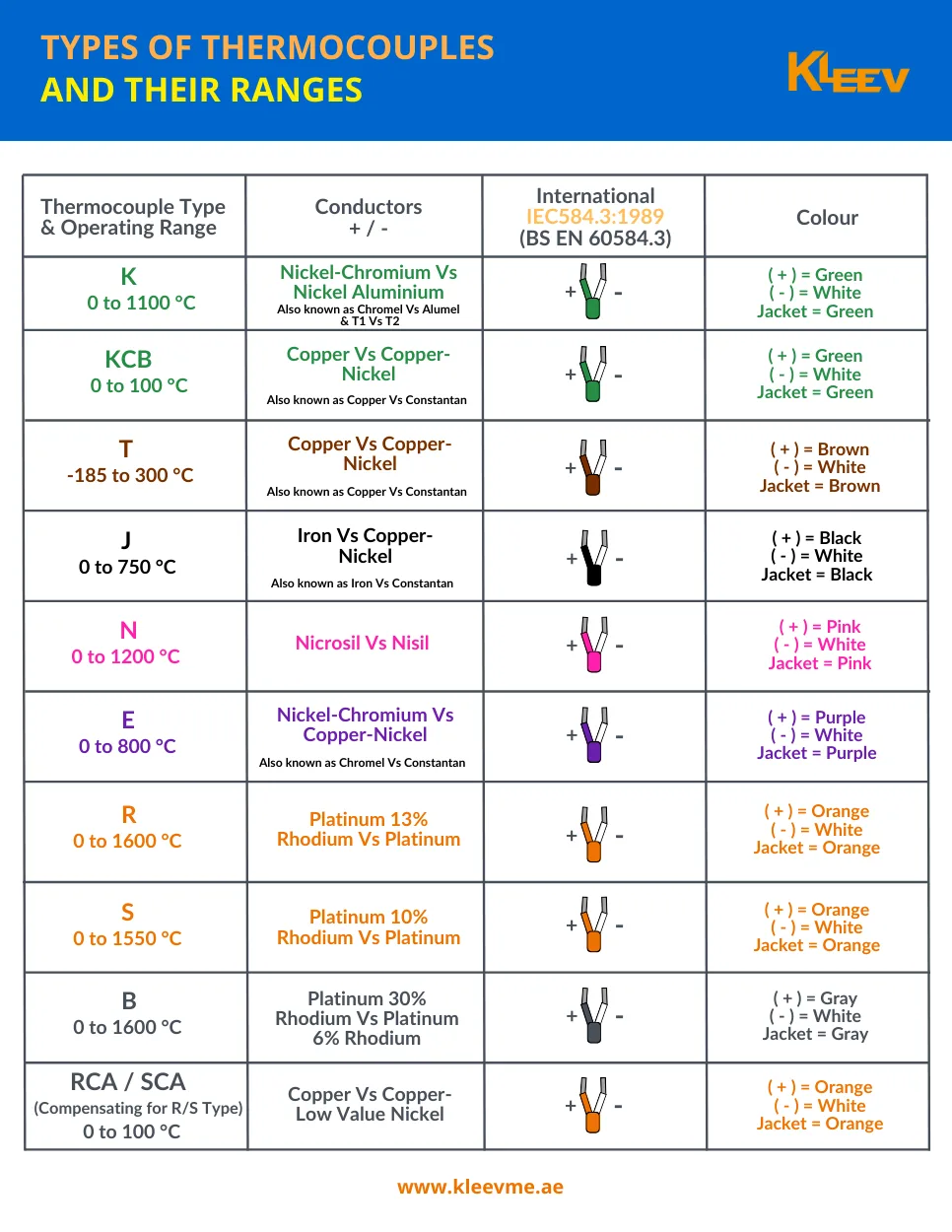
Thermocouple Ranges and color codes
1. Type K Thermocouple (Chromel–Alumel)
Temperature Range: –200°C to 1260°C
Type K is the most commonly used thermocouple worldwide.
Applications:
- General industrial furnaces
- Boilers and heaters
- Heat treatment plants
- Gas turbines
Type K offers a wide temperature range and good resistance to oxidation. It is often the first choice for general-purpose industrial temperature measurement.
2. Type J Thermocouple (Iron–Constantan)
Temperature Range: –40°C to 750°C
Type J is economical and suitable for moderate temperature applications.
Applications:
- Plastic processing
- Low-temperature furnaces
- Vacuum systems
- Molding machines
However, since it contains iron, it is not ideal for high-temperature oxidizing environments.
3. Type T Thermocouple (Copper–Constantan)
Temperature Range: –200°C to 350°C
Type T is known for its excellent performance at low temperatures.
Applications:
- Cryogenic storage tanks
- Cold storage facilities
- Food processing plants
- Laboratory refrigeration systems
When low-temperature stability and accuracy are required, Type T is often selected.
4. Type E Thermocouple (Chromel–Constantan)
Temperature Range: –200°C to 900°C
Type E produces a higher output voltage compared to other base metal thermocouples.
Applications:
- Chemical processing
- Low to medium temperature industrial systems
- Environmental chambers
Its strong signal output makes it useful where signal strength is important.
5. Type N Thermocouple (Nicrosil–Nisil)
Temperature Range: –200°C to 1300°C
Type N was developed to improve the limitations of Type K, especially at high temperatures.
Applications:
- Petrochemical plants
- Refineries
- High-temperature reactors
- Continuous industrial heating systems
Type N offers better resistance to drift and improved long-term stability in high-temperature environments.
6. Type S Thermocouple (Platinum–Rhodium)
Temperature Range: 0°C to 1480°C
Type S belongs to the noble metal thermocouple family.
Applications:
- Laboratory furnaces
- Glass industry
- Precision manufacturing
- Calibration laboratories
It provides high accuracy and stability at elevated temperatures.
7. Type R Thermocouple (Platinum–Rhodium)
Temperature Range: 0°C to 1600°C
Type R is similar to Type S but with a slightly higher temperature limit.
Applications:
- Steel production
- High-temperature kilns
- Critical industrial furnaces
It is selected when both high temperature and high accuracy are required.
8. Type B Thermocouple (Platinum–Rhodium)
Temperature Range: 0°C to 1700°C
Type B can withstand extremely high temperatures.
Applications:
- Glass manufacturing
- Ceramic kilns
- Metal smelting
- High-temperature research facilities
Among all thermocouple ranges and applications, Type B handles the highest temperature capability.
Thermocouple Selection Based on Application
Understanding thermocouple ranges and applications means considering more than temperature alone.
1. Process Atmosphere
Oxidizing environments support the use of Type K and Type N.
Reducing or contaminated environments may require special sheath materials or noble metal thermocouples.
2. Continuous Operation
In 24/7 high-temperature processes, stability becomes critical. Type N often performs better than Type K in long-duration applications.
3. Accuracy Requirements
For general monitoring, base metal thermocouples are sufficient.
For precise temperature control, noble metal types such as S, R, or B are preferred.
4. Mechanical and Environmental Conditions
Consider:
- Vibration levels
- Pressure conditions
- Corrosion risk
- Sheath material (SS, Inconel, ceramic)
- Probe diameter and response time
Proper mechanical design improves sensor life and measurement reliability.
Why Thermocouples Are Widely Used in Industrial Applications
Thermocouples are trusted in industries such as oil and gas, power generation, steel manufacturing, food processing, and chemical plants because they:
- Operate in extreme temperatures
- Withstand harsh process conditions
- Provide fast temperature response
- Offer flexible installation options
- Are suitable for hazardous environments when properly protected
When selected correctly based on thermocouple ranges and applications, they provide reliable long-term temperature monitoring.
Final Takeaway
Thermocouple ranges and applications must be evaluated together to ensure proper sensor performance. Selecting a thermocouple based only on maximum temperature can lead to drift, early failure, and maintenance issues.
A proper evaluation should include:
- Operating temperature
- Process atmosphere
- Accuracy requirement
- Mechanical conditions
- Maintenance accessibility
With correct selection, thermocouples deliver durable, stable, and cost-effective temperature measurement across a wide range of industrial processes.
For industrial projects in the UAE and Middle East, selecting the right thermocouple type and protection assembly is critical to ensure long-term process reliability and safety.
Are you looking to improve your industrial process and your plant’s overall performance?
Our experts can advise you on right thermocouple selection.
Discover our range of Thermocouples.
Follow us on Linkedin, Facebook, Instagram.
250 Views