
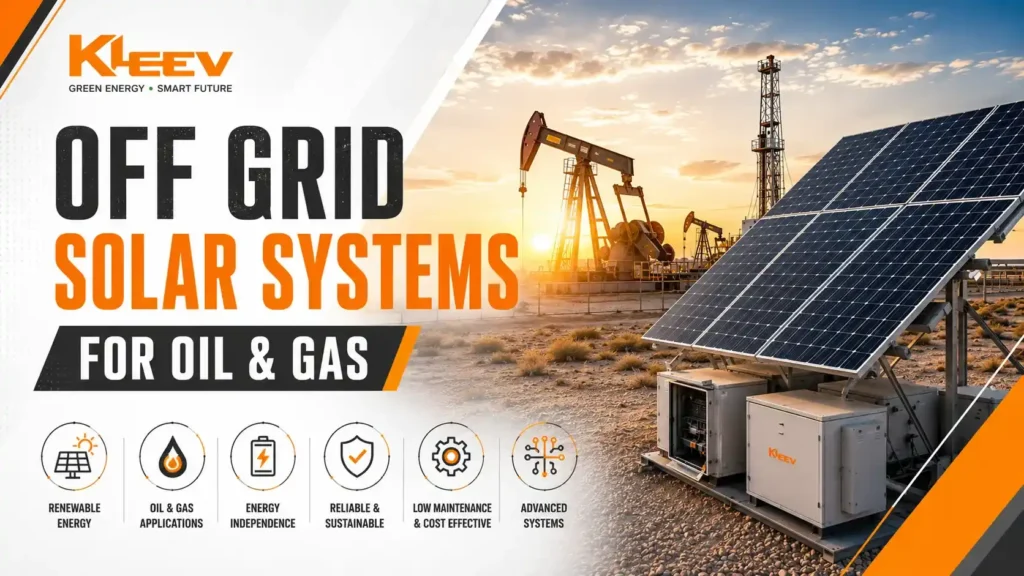
Off Grid Power for Oil & Gas · Engineered in the UAE
Off Grid Solar Systems: Reliable Power for Remote Oil & Gas Sites
How solar power keeps wellheads, pipelines and instrumentation running where the grid does not reach and diesel is too costly to trust.
Oil & GasCathodic ProtectionSCADA & TelemetryHazardous Area
The most critical assets in the oil and gas industry often sit exactly where the electricity grid does not.
Wellheads, pipeline valve stations, cathodic protection points and remote telemetry units are scattered across deserts, coastlines and offshore approaches, far from any power line. For decades the default answer was a diesel generator. Today, off grid solar systems do the same job with none of the fuel, noise or downtime.
This guide explains how solar power supplies remote oil and gas infrastructure, where it delivers the most value, what goes inside a well designed array, and how to size one for continuous, unattended operation. It is written for the same engineers who already trust KLEEV for pressure, temperature, level and flow measurement, and for the certified enclosures that protect it.
01What are off grid solar systems?
An off grid solar system is a self contained power plant that generates and stores its own electricity, with no connection to any utility network. Sunlight is converted to direct current by photovoltaic modules, a charge controller manages that energy, and a battery bank stores it so the load keeps running through the night and through cloudy spells. The result is a quiet, fuel free power source that can run for years with very little attention.
That independence is the whole point. Where a grid connected installation borrows power from the network and a diesel set burns fuel that has to be delivered, an off grid array makes and keeps its own energy on site. For a remote oil and gas asset that may be hours from the nearest road, that difference decides whether a critical safety function stays powered or goes dark. There is no fuel gauge to watch, no delivery schedule to manage and no engine to service, only sunlight, a battery and a controller quietly doing their work.
The KLEEV focus
KLEEV is a specialist in off grid solar systems for oil and gas, designing and building complete packages from the photovoltaic array through charge control, battery storage and the hazardous area enclosures that house the electronics on site.
02Why oil and gas is going off grid solar
Powering a remote site comes down to three broad choices. Extending the grid is slow and enormously expensive over long distances. Diesel generators are quick to deploy but bring a lifetime of fuel logistics, maintenance and emissions. Solar sits between them: a higher upfront design that then runs for years at almost no running cost.
Option A
Grid extension
Reliable once built, but running new lines to a remote wellhead can cost a fortune per kilometre and take many months of permitting and civil work.
Option B
Diesel generator
Fast to install, but every litre of fuel must be trucked in. Refuelling, servicing, theft and downtime make the true cost far higher than the sticker price.
Option C · Recommended
Off grid solar
Higher design effort once, then years of silent, fuel free operation. No refuelling trips, minimal maintenance and no emissions at the point of use.
The comparison sharpens once the full life of the asset is counted. A diesel generator looks cheap on day one, but fuel, filters, servicing, spares and the trips to reach a remote location add up every year it runs, and any missed delivery is a lost load. A solar package carries most of its cost at the start and then asks for very little, so across a ten or fifteen year life the total cost of ownership usually favours solar by a wide margin.
For the Gulf region the case is especially strong. Abundant year round sunshine means a modest array can carry a continuous load, and removing fuel deliveries to scattered sites cuts both cost and risk. Once commissioned, the array simply keeps working, which is exactly what an unattended safety asset needs.
03Where off grid solar delivers most: applications
The value of solar shows up wherever a small but critical load must run continuously in a place the grid forgot. Tap through the main oil and gas applications below.
Cathodic protection
Buried and submerged pipelines rely on impressed current cathodic protection to stop corrosion. These systems need a steady, uninterrupted supply along the whole route, most of it far from any grid. A solar powered rectifier at each station delivers that current year after year without a fuel run.
RTU and SCADA
Remote terminal units, flow computers and radios report pressures, flows and alarms back to the control room around the clock. Losing power means losing visibility of the pipeline. A correctly sized solar system keeps this telemetry live through every night and cloudy day.
Wellhead and valve monitoring
Remote wells and valve stations carry transmitters, actuators and shutdown logic that must stay energised for safety. Solar power systems energise these instruments where running a cable is simply not an option.
Navigation and obstruction lighting
Offshore platforms, jetties and tall structures need aids to navigation and aircraft warning lights that never fail. Solar with battery autonomy keeps these lights burning through the darkest nights, exactly when they matter most.
Security and surveillance
Perimeter cameras, sensors and communications at remote facilities all need dependable power. A standalone solar system runs them without trenching cable across the site.
Chemical Injection Systems
Solar-powered chemical injection systems designed to provide reliable and autonomous power for dosing pumps and instrumentation in remote Oil & Gas facilities. The system is engineered for continuous operation in harsh and hazardous environments, with battery storage to support reliable operation during low-sunlight conditions.
04Inside an off grid solar system
A dependable system is more than a panel and a battery. Five parts work together to turn sunlight into power a critical load can rely on.
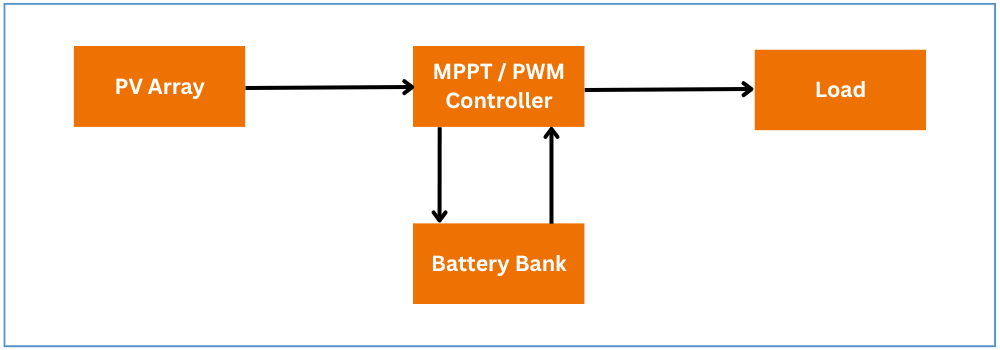
Tap a component ↓
PV Array
MPPT/PWM Controller
Battery Bank
Field Load
Photovoltaic array
Solar modules convert sunlight into direct current. The array is sized for the site's peak sun hours and mounted on corrosion resistant structures angled to capture the most energy across the year.
05Sizing for reliability, not just sunshine
The difference between a system that runs for a decade and one that fails in its first cloudy week is design. Good sizing starts from the load and works backward: how much energy the equipment uses each day, how many days of autonomy it needs when the sun is weak, and how much array is required to refill the battery in between. Get these right and the system becomes genuinely unattended infrastructure.
Autonomy is the figure that separates a hobby installation from industrial infrastructure. A critical cathodic protection or shutdown circuit may need five days or more of storage so it rides through a dust storm or a run of overcast mornings without ever dropping the load. Heat matters too, because a battery in a hot enclosure ages faster and delivers less, so the Gulf climate has to be designed in from the outset rather than discovered later.
06Built for heat, dust and hazardous zones
A remote solar system in the Gulf faces punishing conditions: extreme heat, blowing sand, salt air near the coast and, on an oil and gas site, an explosive atmosphere. Hardware that would last for years in a mild climate can degrade quickly here, so every part is chosen for the environment it must survive.
In practice that means modules with robust framing and glass that shrugs off sand abrasion, batteries selected and housed to cope with high ambient temperature, mounting structures in hot dip galvanised or stainless steel, and cabling rated for constant ultraviolet exposure. Small choices like these decide whether the array is still performing to specification in year ten.
IP66
Enclosure rating
Ex
Hazardous area
316L
Stainless options
MPPT
Charge control
This is where KLEEV's two specialisms meet. The same certified housings from the KLEEV enclosure range protect the charge controllers, batteries and terminals of an off grid solar system inside a classified zone. You can read more in our guide to Ex proof enclosures, which explains the zone and marking system that governs any electrical equipment near flammable gas or dust.
07Standards and quality
Reliable solar power systems are built on recognized international standards. Photovoltaic modules are qualified in accordance with IEC 61215 for design qualification and IEC 61730 for safety, while power electronic equipment is designed and evaluated in accordance with applicable IEC 62109 requirements.
For installations in classified hazardous areas, electrical equipment is selected and certified in accordance with the applicable IEC 60079 series requirements for explosive atmospheres. Where the application involves Cathodic protection, corrosion-control practices may also follow recognized guidance from organizations such as AMPP.
08Frequently asked questions
Yes. The battery bank is sized to carry the load overnight and through several days of poor sun, so a correctly designed system delivers continuous power. The number of autonomy days is a key design choice for critical oil and gas duties.
Very little compared with a diesel generator. There is no fuel and no engine. Periodic checks of the modules, connections and battery condition are usually enough, which is a major reason remote sites move to solar.
The panels sit outside the classified area, and the electronics are housed in certified Ex enclosures rated for the zone. This lets a solar system serve wellheads, pipelines and other locations with a flammable atmosphere.
It depends on the load, its run time and the autonomy required. The estimator above gives a rough feel; a firm design also weighs site temperature, battery type and cable runs. Share your load list with KLEEV for an exact specification.
09The bottom line
Remote oil and gas assets cannot afford to lose power, and they cannot always wait for a fuel truck. Off grid solar systems answer both problems at once: independent, fuel free power that keeps cathodic protection, telemetry, safety instruments and lighting running through every night and every cloudy spell. The upfront design effort is repaid many times over in years of silent, low maintenance operation.
KLEEV designs and builds off grid solar systems for oil and gas across the region, pairing decades of instrumentation and enclosure expertise with solar engineering built for the toughest sites in the Gulf.
Power your remote site with KLEEV solar
Send us your load list or site details. Our engineering team will size a complete off grid solar system, including certified enclosures, and return a specification and quotation.
KLEEV Middle East FZE · P.O. Box 17259, Plot MO0767, JAFZA (North), Dubai, UAE
121 Views