
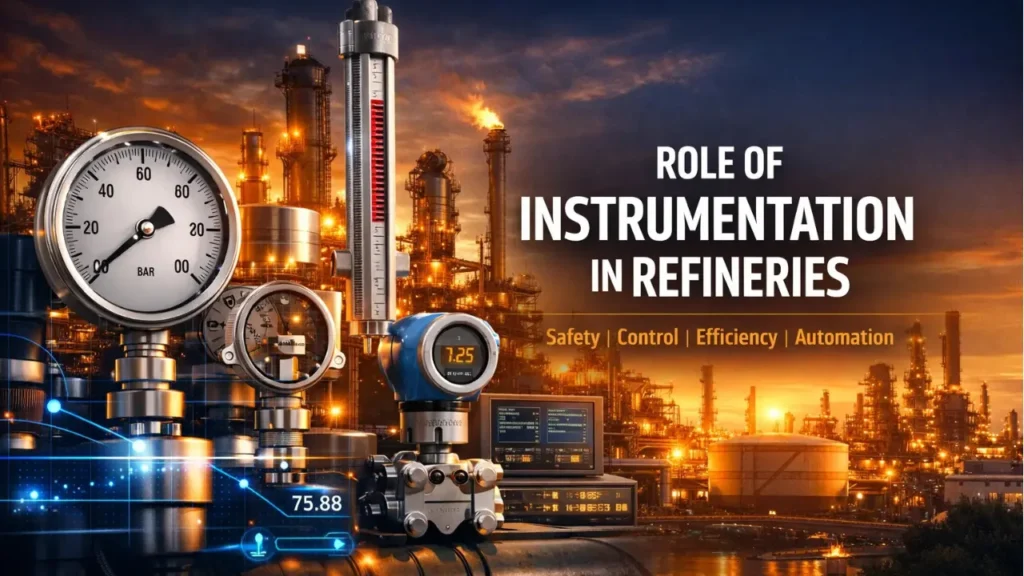
Role of Instrumentation in Refineries – The Backbone of Modern Oil & Gas Plants
Refineries are among the most complex industrial facilities in the world. They operate continuously under extreme conditions high temperatures, high pressures, flammable hydrocarbons, and interconnected processing units.
In such an environment, precision is not optional.
This is where the role of instrumentation in refineries becomes critical.
Instrumentation acts as the nervous system of a refinery. Just like the human body depends on nerves to sense and react, a refinery depends on instruments to measure, monitor, and control every part of the process.
Without reliable instrumentation, refining operations would be unstable, inefficient, and potentially dangerous.
Let us understand this in detail.
Refinery Process Units That Depend on Instrumentation
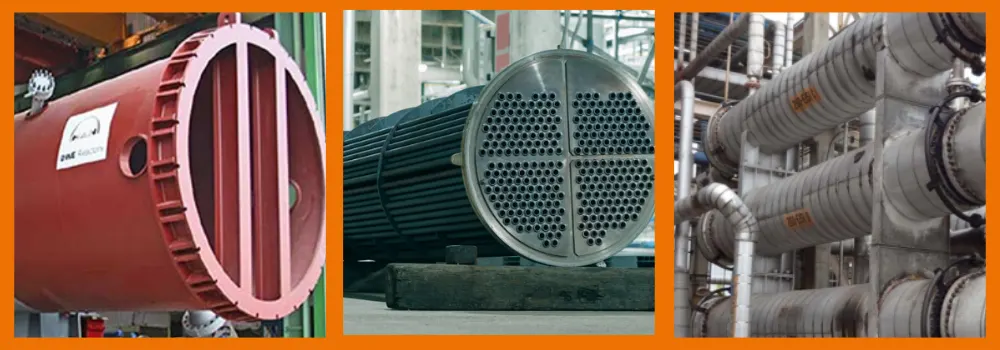
A refinery contains multiple interconnected process units such as:
-
Distillation Columns
-
Reactors
-
Furnaces and Heaters
-
Compressors and Pumps
-
Heat Exchangers
-
Storage Tanks and Terminals
Each of these units depends on accurate measurement of process variables to function safely and efficiently.
Even a small deviation in temperature or pressure can lead to off-spec products, equipment damage, or safety hazards.
Measurement and Monitoring – The Primary Role
The first and most fundamental role of instrumentation in refineries is measurement.
Refineries continuously measure four primary process variables:
-
Temperature
Temperature measurement determines reaction rates, product separation, and energy efficiency.
For example, the temperature profile inside a crude distillation column directly affects the separation of LPG, naphtha, diesel, and residue fractions. -
Pressure
Pressure monitoring prevents equipment rupture, column collapse, and unsafe operating conditions.
Overpressure is one of the most dangerous risks in refining operations. -
Flow Rate
Flow measurement ensures correct feed rates, product transfer, and fuel control in furnaces.
Incorrect flow can disturb material balance and reduce plant efficiency. -
Level
Level instruments prevent tank overflows, dry-running pumps, and improper separation in vessels.
These measurements give operators real-time visibility into plant conditions.
In modern refineries, transmitters continuously send signals to control systems for instant analysis and response.
Process Control and Automation
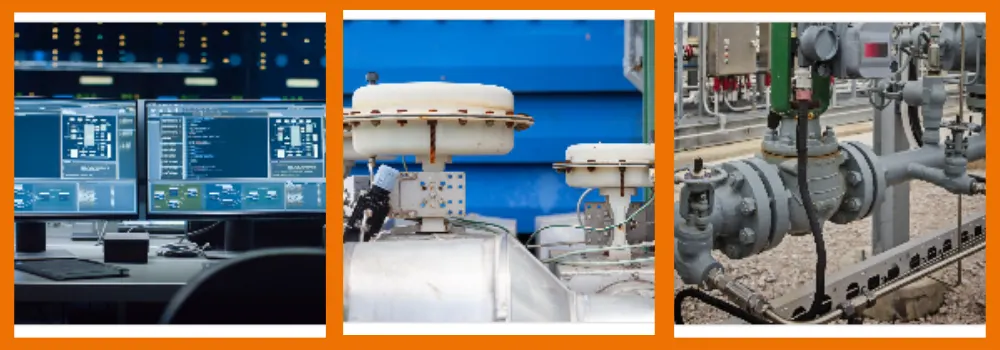
Measurement alone is not enough.
The real power of instrumentation lies in automation.
Signals from field instruments are transmitted to control systems such as:
-
Distributed Control System (DCS)
-
Programmable Logic Controller (PLC)
These systems compare measured values with predefined setpoints.
When deviations occur, automatic corrective actions are taken:
-
Control valves adjust flow.
-
Pumps increase or decrease speed.
-
Heaters regulate temperature.
-
Compressors adjust pressure.
This closed-loop control keeps the refinery stable 24/7.
Automation reduces human error, improves consistency, and allows refineries to operate continuously with minimal downtime.
In large Gulf refineries, thousands of control loops operate simultaneously all dependent on accurate instrumentation.
Safety – The First Line of Defense
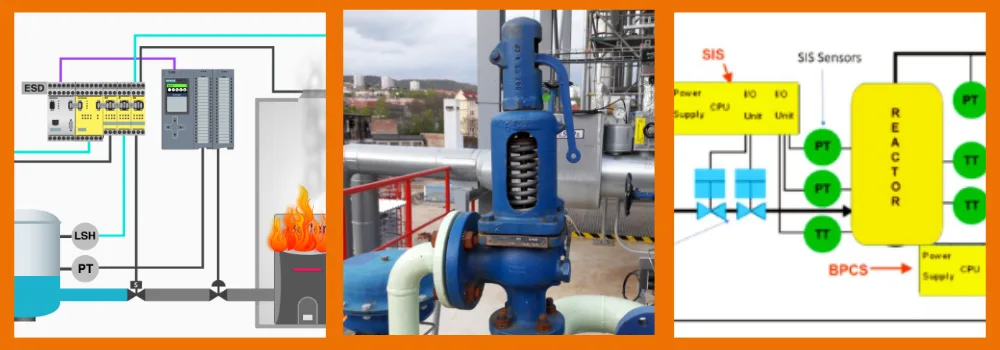
Refineries operate under hazardous conditions:
-
High temperature
-
High pressure
-
Flammable hydrocarbons
-
Toxic gases
Here, instrumentation plays a life-saving role.
Safety Instrumented Systems (SIS) use sensors and transmitters to detect abnormal conditions such as:
-
High pressure
-
High temperature
-
Low flow
-
Gas leakage
When limits are exceeded, automatic actions are triggered:
-
Alarm generation
-
Emergency shutdown
-
Activation of relief systems
-
Isolation of process sections
In many Middle East refineries, compliance with international safety standards is mandatory.
Without reliable instrumentation, even the most advanced safety systems cannot function effectively.
Energy Efficiency and Optimization
Energy is one of the largest operating costs in refineries.
Instrumentation helps optimize energy consumption in several ways:
-
Monitoring fuel flow in furnaces.
-
Measuring temperature across heat exchangers.
-
Tracking steam flow distribution.
-
Detecting fouling or performance losses.
By analyzing instrument data, engineers can:
-
Improve heat recovery.
-
Reduce fuel consumption.
-
Optimize combustion efficiency.
-
Minimize emissions.
Even a small improvement in furnace efficiency can save millions annually in large refineries.
Instrumentation makes this optimization possible.
Predictive Maintenance and Asset Protection
Modern digital refineries use instrumentation data for predictive maintenance.
Instead of waiting for equipment failure, engineers monitor:
-
Differential pressure across filters.
-
Vibration trends in pumps and compressors.
-
Temperature rise in bearings.
-
Flow imbalance in parallel lines.
Abnormal trends indicate early problems.
This allows maintenance teams to act before catastrophic failure occurs.
Predictive maintenance reduces downtime, prevents accidents, and extends equipment life.
Product Quality and Regulatory Compliance
Refineries must meet strict product specifications and environmental regulations.
Instrumentation ensures:
-
Accurate blending of products.
-
Proper sulfur control.
-
Controlled emissions.
-
Safe discharge limits.
Accurate measurement prevents off-spec production and costly reprocessing.
In regions like UAE and Qatar, environmental compliance is strictly monitored.
Reliable instrumentation ensures refineries remain compliant and competitive.
The Digital Refinery – Data-Driven Operations
Today’s refineries are moving toward digital transformation.
Instrumentation data is used for:
-
Advanced analytics
-
Optimization algorithms
-
Real-time dashboards
-
Digital twins
With thousands of sensors installed across the plant, engineers can simulate operations, predict outcomes, and optimize performance.
The role of instrumentation in refineries is no longer limited to measurement.
It has become the foundation of smart refining.
Why Reliable Instrumentation Matters More Than Ever
In a refinery:
-
One faulty pressure reading can cause shutdown.
-
One inaccurate level transmitter can cause overflow.
-
One failed temperature sensor can damage a reactor.
Reliability, accuracy, and proper installation are critical.
That is why selecting high-quality industrial instruments and explosion-proof equipment is essential for refinery applications.
Key Takeaways
The role of instrumentation in refineries goes far beyond simple measurement.
Instrumentation:
-
Enables real-time monitoring.
-
Maintains process control and automation.
-
Protects equipment and personnel.
-
Optimizes energy efficiency.
-
Ensures product quality.
-
Supports regulatory compliance.
-
Powers digital transformation.
It is truly the backbone of safe, efficient, and profitable refinery operations.
Without instrumentation, modern refining would not be possible.
Feel free to share this blog with your colleagues and friends who might find it useful.
1,147 Views